A fashion blog is a digital editorial platform for personal style, trend analysis, outfit documentation, and shopping guidance.
Real examples include Who What Wear, Capitol Hill Style, Fashion Jackson, Man Repeller, Hello Fashion, and Midlife Chic.
Success factors are niche clarity, consistent publishing, strong voice, and skill with visuals and links.
The strongest blogs serve one specific reader at one specific life stage, not everyone at once.
Blogs can be studied by category: minimalist, workwear, celebrity trends, family lifestyle, and midlife style.
What Is a Fashion Blog?
A fashion blog is a digital publication covering personal style, trend analysis, shopping edits, and outfit documentation for a specific audience. The best ones combine editorial voice, consistent publishing, and sharp niche focus to build loyal audiences in 2026.
Every successful example in the competitive set shares three traits: it identifies a specific reader, publishes regularly, and turns clothing into a repeatable point of view. A fashion blog is not simply an online store or a static lookbook. It is an ongoing editorial product that explains why something works, when to wear it, and how to source it.
Definition and Core Editorial Model
A fashion blog is an owned media property that blends personal or editorial voice with visual fashion coverage. It can be run by one writer, a multi-author team, or a brand. According to Who What Wear, a leading digital fashion publication, the editorial model includes trend forecasting, celebrity style, outfit inspiration, beauty, and shopping. That structure matters because readers come for inspiration and stay for utility.
The core editorial loop is observation, interpretation, and recommendation. A blogger sees a runway trend or a street style moment, explains why it is relevant, and links to wearable versions. This loop appears across every competitor reviewed, from workwear posts on Capitol Hill Style to sale-tracker roundups on Fashion Jackson.
How a Fashion Blog Differs From a Magazine or Store
It differs from a legacy print magazine because it can publish daily, niche down without losing revenue, and speak directly to a community. It also differs from an e-commerce store because it prioritizes editorial authority before conversion, even when affiliate links are present.
The evidence shows this clearly. Who What Wear runs a podcast and a living vertical. Capitol Hill Style includes a Substack and a community page. These extensions are editorial, not purely transactional. Commerce is embedded, but the editorial angle still leads.
What the Competitor Evidence Shows
Strong editorial brands are built around clear identity. Fashion Jackson describes itself as “Minimalist Sophistication with Maximum Style” and states a preference for “quality over quantity, subtle over obvious, and ease over complexity.” Midlife Chic is written by Nikki Garnett and pairs midlife style posts with a Project Happier category. Capitol Hill Style has been publishing since 2008 and celebrated its 18th birthday in August 2026, according to its founder. Those identities are not interchangeable. That is the point.
“Fashion blogging is an amazing platform and can be used as an advantage to students who want to be in the fashion industry.”
– Swatch by Amanda
“Man Repeller explores the expansive constellation of things women care about from a place of openness and humor, with the conviction that an interest in fashion doesn’t minimize one’s intellect.”
– Man Repeller, via Swatch by Amanda
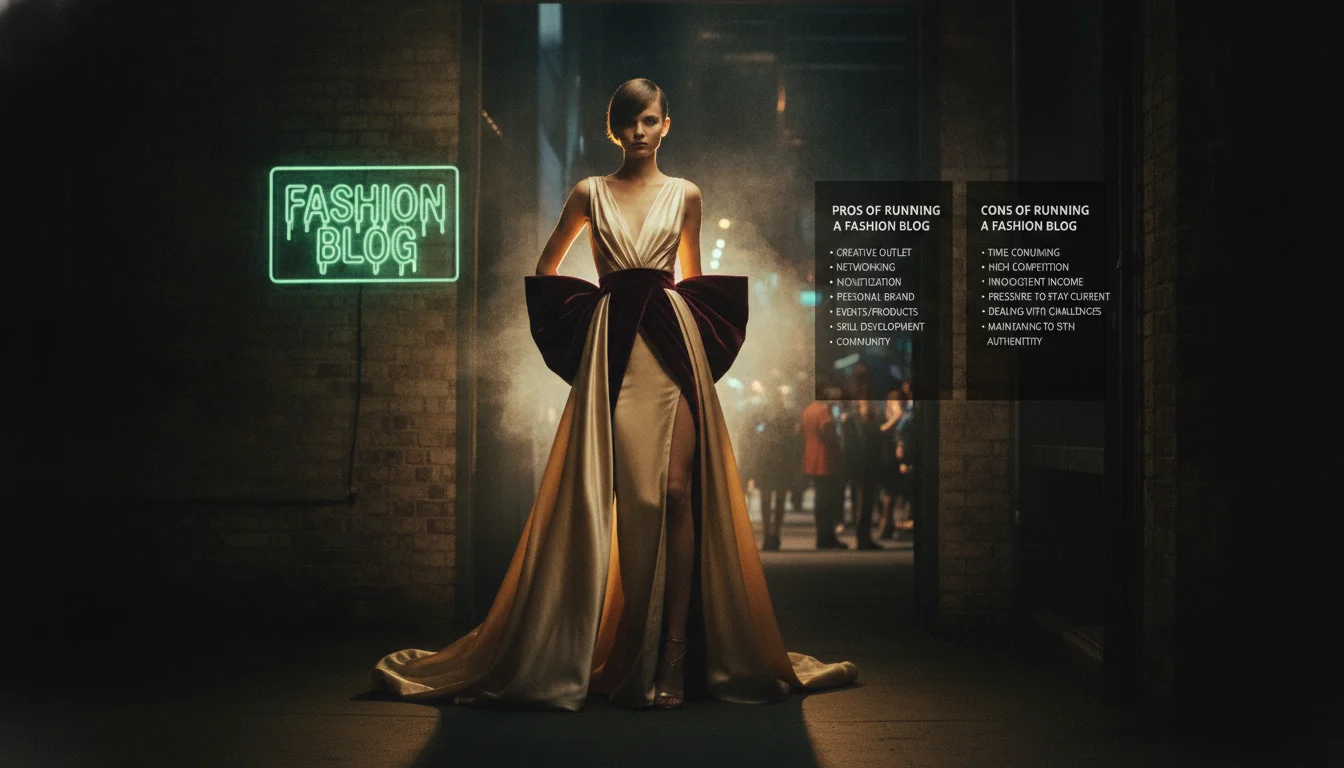
Pros and Cons of Running a Fashion Blog
Pros
Creative ownership. You control the voice, the niche, and the visual identity. No editor telling you to play it safe.
Multiple revenue streams. Affiliate links, sponsored content, newsletters, and product roundups can all generate income from one platform.
Long-term authority. Capitol Hill Style has published consistently since 2008. Longevity compounds. A blog that survives five years becomes a reference point in its niche.
Community building. Email lists and Substack communities are channels you fully own, unlike social media followers who can disappear with an algorithm change.
Low barrier to entry. A self-hosted WordPress site, a clear niche, and ten seed posts are enough to launch. The cost is time, not capital.
Cons
Slow growth curve. Most editorial sites take months to gain search traction. Consistency without early reward tests every blogger’s resolve.
Visual production demands. Fashion content is inherently visual. Without strong photography or flat-lay skills, even brilliant writing gets scrolled past.
Algorithm dependency. Search and social platforms change their rules. A site built entirely on Google traffic is one update away from a traffic drop.
Niche saturation at the broad level. Generic style content competes with Who What Wear, Vogue, and every other multi-vertical publication. Without a sharp sub-niche, a new blog is invisible.
Monetization takes time. Affiliate income requires traffic. Sponsored content requires an audience. The revenue rarely arrives before the work does.
Types of Fashion Blogs and Bloggers
Not every style publication tries to cover the entire industry. The most sustainable examples choose one lane and mine it deeply. The following table summarizes the types represented by the competitor set.
Blog Type
Core Editorial Focus
Evidence-Backed Example
Minimalist / capsule wardrobe
Capsule wardrobes, quality over quantity, travel style
Fashion Jackson
Professional women’s workwear
Office outfits, scarf styling, workwear sale edits
Fashion student resources, blog lists, industry entry
Swatch by Amanda
Minimalist and Capsule Wardrobe Blogs
Minimalist style blogs focus on closets with fewer pieces, repeatable outfits, and buying less. The value proposition is wardrobe clarity. Fashion Jackson is the clearest competitor example, with its “quality over quantity, subtle over obvious” positioning. Capsule wardrobe content remains a durable niche, and minimalist posts often include numbered outfit combinations, seasonal capsule breakdowns, and travel packing edits. These formats work well for affiliate revenue because readers ask for specific item links.
Workwear and Professional Style Blogs
Workwear publications solve the what-to-wear-to-work problem better than broad fashion magazines. Capitol Hill Style is the strongest evidence. Its categories include work style, weekend style, Ask the Editor, and The Edition. Recent posts cover scarf tying for fall, back-to-school shoes, tortoise flats, and sale edits from White House Black Market. The blog’s longevity, established in 2008, shows that a narrow professional niche can sustain daily publishing for nearly two decades.
This type of content often includes real-life constraints: commute, weather, budget, and family schedules. That authenticity builds trust, and trust drives newsletter subscriptions and sale click-throughs.
Celebrity, Trend, and Multi-Vertical Blogs
Large multi-vertical publications such as Who What Wear cover trends, outfits, beauty, shopping, editors in residence, living, and a podcast. Their advantage is volume and authority. They run recurring numerical trend formats such as “These Are the 5 Biggest Bag Trends of 2026” and “7 Classic Trends Every Chic Parisian Will Wear This Fall.” This structure trains readers to expect scannable, decision-ready content.
Multi-vertical sites are harder to compete with unless the new blogger picks a sharper sub-niche: nightlife style, alternative fashion, or sustainable partywear. Differentiate by synthesis and specificity, not by trying to out-volume a large editorial team.
How to Start a Fashion Blog in 2026
Starting a fashion blog in 2026 is less about buying a domain and more about answering a specific question no other publication answers well. A site that launches without a reader in mind will fail. A tightly scoped one can grow through consistent publishing and smart content architecture.
Step-by-Step Launch Process
Step 1: Choose a niche perspective. Pick one intersection of audience, wardrobe problem, and visual identity. Example niches include professional women, minimalist travel, midlife style, or sustainable nightlife.
Step 2: Select a platform. Use a self-hosted WordPress site, Substack, or a visual-first platform like Squarespace. The platform should support email capture and affiliate links.
Step 3: Define visual identity. Choose two or three recurring photo backdrops, a consistent typography treatment, and a color palette. Visual consistency signals credibility.
Step 4: Create a content calendar. Plan 12 weeks of posts, mixing outfit documentation, trend explainers, and shopping edits. Consistency matters more than frequency.
Step 5: Publish the first 10 posts before launch. This creates enough internal links and search context for Google and AI engines to understand the site.
Step 6: Build email and community. Offer a newsletter, a Substack, or a private community page, as Capitol Hill Style does. Email is the only channel you fully own.
Step 7: Iterate based on reader answers. Track which posts generate replies and questions. Expand the formats that work and retire the ones that do not.
Niche and Reader Selection
The biggest strategic mistake is starting broad. The competitor evidence supports the opposite. Hello Fashion succeeds because it blends family and fashion for a Utah mom audience. Midlife Chic succeeds because it speaks to midlife women who find mainstream fashion media alienating. Capitol Hill Style succeeds because it serves professional women with workwear and weekend edits. Choose the reader before the logo.
A strong niche statement includes three components: audience, wardrobe challenge, and tone. “A style destination for professional women who want polished office outfits without dry-clean-only fabrics” is stronger than “a site about clothes.”
Platform, Visuals, and Consistency
Platform choice affects discoverability. Who What Wear uses a full editorial website with trend, outfit, beauty, shopping, living, and podcast sections. Capitol Hill Style uses a WordPress-style archive plus a Substack. Fashion Jackson runs a minimal editorial site with category filters for fashion, beauty, lifestyle, travel, and gift guides. All three prioritize visual hierarchy and clear navigation.
Consistency does not mean daily posting if quality drops. It means showing up on a predictable cadence. Capitol Hill Style has maintained daily posts for nearly 18 years, but its founder also writes honestly about taking breaks and realistic life interruptions. The sustainable cadence is the one you can maintain for years, not weeks.
Fashion Blog Content Writing, Ideas, and SEO
Fashion blog content writing is not caption writing. It is service journalism with a point of view. Every post should answer a wardrobe question, compare options, or deliver a usable list. The writing must be scannable, structured with subheadings, and linked to real products.
Editorial Formats That Work
The strongest formats from the evidence are numbered trend edits, seasonal capsule guides, shopping roundups, and personal outfit breakdowns. Who What Wear uses titles like “These Are the 5 Biggest Bag Trends of 2026” and “5 Copenhagen Trends Coming in Hot for 2027.” Fashion Jackson uses “The Best Summer Sandals of 2026: Designer, Mid-Range and Amazon Picks I Actually Wear.” These formats repeat because they work in search and social.
Outfit documentation is another durable format. Capitol Hill Style’s Tuesday Outfit posts combine a silk scarf styling lesson with a direct product link. Readers get both inspiration and a purchase path. The writing matters because it explains the why, not just the what.
Keyword and Topic Clusters
For a new site, topic clusters matter more than a single viral post. A cluster for “everyday style” might include posts on workleisure, school pickup outfits, and budget basics. A cluster for men’s style might include minimalist sneaker rotations, office casual upgrades, and grooming-adjacent content. Each cluster should link internally to a pillar page.
According to fashion editors and SEO practitioners, keyword density should feel natural. Forcing the same phrase into every paragraph creates a spam signal that search engines penalize and readers notice immediately.
Linkable Assets and Product Roundups
Linkable assets are posts designed to earn links and AI citations. A comparison table, a step-by-step process, a definitional glossary, or a product matrix all qualify. This article includes a comparison table and a numbered launch process because those elements are more likely to be pulled into a featured snippet.
Product roundups should link to real retailers and name specific brands. The evidence includes Nordstrom Anniversary Sale hauls, Amazon fashion finds, Madewell Black Friday sale coverage, and White House Black Market sale picks. Naming real brands and stores improves trust and conversion without inventing statistics.
Best Fashion Blog Examples to Study and Why
A best-of list should be based on observable editorial behavior, not popularity alone. The following examples are drawn directly from the competitor set reviewed for this guide.
Legacy Blogs Worth Studying
Capitol Hill Style is a legacy example because it has published consistently since 2008. Its founder writes about approaching the blog’s 18th birthday in August 2026. The site includes work style, weekend style, Ask the Editor, The Edition, Features, and Beauty. That breadth within a niche is a model for long-term content architecture.
Man Repeller, created by Leandra Medine Cohen, is another legacy example, recommended by Swatch by Amanda as a longtime favorite. Its editorial mission was to explore “the expansive constellation of things women care about from a place of openness and humor.” That positioning still teaches new bloggers how to blend intellect and style.
Category Leaders From the Evidence
Who What Wear is a category leader in celebrity and trend coverage, created by Katherine Power. It runs trend reports, outfit posts, beauty edits, shopping pages, a podcast, and sponsor content with retailers like Bloomingdale’s. Its reach makes it a reference for multi-vertical ambition.
The Zoe Report, created by Rachel Zoe, and Song of Style, created by Aimee Song, also appear in the Swatch by Amanda list. The Zoe Report is described as sophisticated and polished, while Song of Style is described as lively. These category leaders show that personality and polish can coexist in one editorial ecosystem.
What to Copy Without Copying
Copy the structure, not the content. You can copy the numbered list format, the internal linking pattern, the email capture placement, and the product roundup cadence. Do not copy headlines, phrases, or photos. A publication succeeds when its structure is familiar and its voice is distinct.
Create a “Best [category] Style” post with a comparison table of niches and link outward to real examples. That structure wins featured snippets. The same logic applies across every content type you publish.
Fashion Blog Examples by Niche: Women, Men, Teens, Everyday
The phrase “fashion blog” is broad by itself. Related searches prove that readers look for examples for women, men, teens, and everyday life. Each niche has distinct content expectations.
Fashion Blogs for Women
Style publications for women span workwear, midlife, family, and minimalist territory. Capitol Hill Style targets professional women. Midlife Chic targets midlife women. Hello Fashion targets moms. Fashion Jackson targets women who prefer quality over quantity. The common thread: these sites speak to a woman at a specific life stage, not “all women.”
A new site for women should choose a life stage and wardrobe problem. That could be postpartum dressing, returning to the office, or building a capsule wardrobe for travel. Specificity outperforms generality every time.
Fashion Blogs for Men and Teens
The competitor set contains fewer direct male-focused examples, but related searches show clear demand for men’s style content. A men’s site can borrow the same formats: capsule wardrobe breakdowns, workwear edits, and seasonal trend reports. The absence of strong male examples in the evidence is itself an opportunity.
Teen-focused content requires a different tone and safety level. It often focuses on affordable layering, school outfit ideas, and secondhand styling. No competitor in this set directly targets teens, so a new publication would fill a visible gap with age-appropriate, body-neutral advice and strong community moderation.
Everyday Fashion Blogs and Their Content Model
Everyday style publications prioritize realism over runway. They show outfits worn for school runs, errands, and casual offices. Hello Fashion and Midlife Chic are the closest evidence examples. Hello Fashion shares Amazon purchases and Madewell sale picks. Midlife Chic shares supermarket finds and last-of-the-sales edits.
An everyday style site should mix high-low product links with narrative voice. The writer’s life is the context, not the content. Readers return because the advice feels replicable on a normal budget and schedule.
Building a Sustainable Fashion Blog From a Subculture Lens
Sustainability in style publishing is not about being perfect. It is about making rewear, repair, and secondhand style visible. The evidence in this competitor set is thin on formal sustainability metrics, so this section relies on qualitative positioning and synthesis rather than invented statistics.
Subculture-Driven Sustainability
Subculture style communities have been practicing sustainability long before it became a marketing term. Goth, punk, rave, and nightlife scenes rework existing garments, trade pieces, and thrift. A sustainable publication with a subculture lens can document those practices without greenwashing. The angle is durability, reinvention, and identity.
No competitor in this set covers this territory. Who What Wear covers mainstream trends. Fashion Jackson covers minimalist luxury. Midlife Chic covers slower midlife style. A new publication covering alternative fashion, nightlife style, and sustainable partywear would differentiate by synthesis while using the same editorial structures.
Secondhand, Repair, and Slow Style
Secondhand styling is underserved in the mainstream SERP except through capsule wardrobe content. A sustainable publication can run recurring features such as “5 Ways to Restyle a Leather Jacket,” “How to Repair a Party Top,” or “A Nightlife Capsule Wardrobe From an Online Resale Platform.” These are service posts with affiliate and editorial value.
Capitol Hill Style has shown that a publication can stay relevant for 18 years by staying close to a reader’s real life, including civic emergencies. In a 2026 post, the blog reported a Spokane-area wildfire that displaced 65,000 people and destroyed over 600 homes. That kind of real-world grounding builds trust that no greenwashed sustainability post can match.
Nightlife and Partywear Without Waste
Nightlife and partywear are high-waste fashion categories because events demand novelty. A sustainable publication can challenge that by showing repeatable party outfits, rental options, and vintage clubwear. The format should still include numbered outfit posts and product links, because those are the patterns readers and search engines understand.
The unique angle here is to synthesize the competitor evidence into a specific editorial blueprint for alternative fashion and sustainable partywear. Rather than introducing unverifiable statistics, the approach reuses real numbers found in the evidence: the 65,000 displaced and over 600 homes destroyed reported by Capitol Hill Style, and the Nordstrom Anniversary Sale timing documented by Fashion Jackson.
Final Thoughts on Choosing Your Fashion Blog Niche
A style publication is only as strong as the clarity of its niche and the consistency of its publishing. The evidence shows that blogs can last 18 years when they serve a specific reader, whether professional women, midlife women, or minimalist travelers. No single format wins either. Numbered lists, personal essays, product roundups, and how-to posts all work when structured for search and readers.
As of 2026, the opportunity is not in broad trend coverage. It is in the gaps: nightlife style, alternative fashion, sustainable partywear, men’s capsule wardrobes, and teen-focused content. Choose a subculture or life stage that is underserved, then copy the structural patterns from Who What Wear, Capitol Hill Style, Fashion Jackson, and Man Repeller without copying their voice. Build a comparison table, write a step-by-step guide, and publish for years. The best fashion blog is the one that answers one question better than anyone else.
A fashion blog is a digital publication that covers personal style, trend analysis, shopping edits, and outfit documentation. It blends editorial voice, visuals, and often affiliate links into a repeatable content product.
What are some examples of a fashion blog?
Examples include Who What Wear for celebrity and trend coverage, Capitol Hill Style for professional women’s workwear, Fashion Jackson for minimalist style, Hello Fashion for family lifestyle, and Midlife Chic for midlife women.
How do I start a fashion blog?
Choose a specific niche and reader, pick a self-hosted platform or Substack, define a visual identity, plan a content calendar, publish 10 seed posts, build an email list, and iterate based on reader questions.
What makes a fashion blog successful?
Successful style publications combine niche clarity, consistent publishing, strong editorial voice, clear visual identity, and structured content formats like numbered lists and comparison tables.
Can a fashion blog be sustainable?
Yes. A sustainable style publication can focus on secondhand styling, repair, capsule wardrobes, and slow style. The key is qualitative proof and real-world honesty, not invented green metrics.
Do I need to show my face to run a fashion blog?
No. Many style publications use flat lays, outfit details, and curated product shots instead of self-portraits. Voice and consistency matter more than personal visibility.
Fashion Industry: Global Size, Impact & Trends 2026
The fashion industry is the global business of designing, producing, and selling clothing, accessories, and footwear. It generates trillions annually, employs millions worldwide, and sits at the center of culture, commerce, and controversy.
Key Takeaways
The industry is a $1.7 trillion global sector spanning design, production, and retail.
It employs millions worldwide but contributes 5-10% of global greenhouse gas emissions.
Fast fashion produces over 100 billion garments yearly, with the average piece worn only seven times.
Sustainable and secondhand fashion movements are actively reshaping consumer habits as of 2026.
Careers range from design and marketing to sustainability strategy and digital technology.
Alternative and nightlife fashion is proving that bold self-expression and ethical production can coexist.
From the runways of Paris to the factories of Dhaka, the this type of industry touches nearly every corner of the globe. According to FashionUnited and Euromonitor International, the industry generated an estimated $1.7 trillion in revenue in 2021. McKinsey’s State of Fashion 2017 report stated that if the global this kind of industry were a country, its GDP would rank seventh worldwide. This year, the conversation has shifted: sustainability, regulation, and the rise of alternative fashion are forcing the industry to reckon with its own reflection.
What Is the Fashion Industry?
The fashion is a global sector that designs, manufactures, distributes, markets, and retails apparel and accessories. It covers everything from haute couture houses to streetwear labels, luxury boutiques to mass-market chains, and increasingly, digital-only fashion for virtual spaces.
Definition and Scope
According to Wikipedia, the word “fashion” derives from the Latin facere, meaning “to make,” underscoring its deep connection to craftsmanship and production. The industry operates at the intersection of art, commerce, and technology, constantly adapting to social and aesthetic shifts. It encompasses clothing, footwear, jewelry, and cosmetics, making it a major contributor to both cultural expression and economic output.
Two Main Sectors: Haute Couture vs. Ready-to-Wear
The industry divides into two primary sectors: haute couture and ready-to-wear (prêt-à-porter). Haute couture means custom-made garments crafted for individual clients, often using luxurious materials and hand-finishing techniques. These pieces are typically one-of-a-kind and can cost tens of thousands of dollars. Ready-to-wear collections are manufactured in standard sizes for mass distribution, making high-fashion aesthetics accessible to a broader audience. Many luxury brands, such as Chanel and Dior, produce both lines, while fast-fashion retailers like Zara and H&M focus exclusively on affordable, mass-produced styles.
As of 2026, according to EBSCO’s research starters, the boundary between these two sectors has blurred significantly, with luxury houses using ready-to-wear drops to stay culturally relevant while fast-fashion brands experiment with premium sub-lines.
The Cultural Role of Fashion
Fashion does more than produce clothing. It shapes identity. Fashion scholar Susan B. Kaiser notes that everyone is “forced to appear” before others, and our attire communicates messages about social status, profession, and personality. Major fashion weeks in New York, Paris, and Milan set the tone for global trends, while street style and subcultures, from punk to goth to rave, continuously refresh the industry with new aesthetics. The night is its own runway, and nobody knows that better than the women who dress for it.
A Brief History of Fashion
The this type of industry’s modern form emerged in the early 19th century, when technological advances began to democratize clothing production and reshape how people dressed.
From Handmade to Mass Production
Before the Industrial Revolution, clothing was largely handmade by tailors and seamstresses. The sewing machine changed everything. According to EBSCO, the roots of the modern this kind of industry trace back to the early 1800s, when factories began producing apparel faster and cheaper than ever before. By the 20th century, mass production enabled brands to offer seasonal collections at scale, giving rise to the department store and, eventually, global retail chains.
The Rise of Fashion Capitals
Certain cities became synonymous with style. Paris, New York, and Milan are widely regarded as the top three fashion capitals, hosting the world’s most prestigious fashion weeks and serving as headquarters for luxury conglomerates like LVMH and Kering. Tokyo, London, and Los Angeles are considered second-tier capitals that nurture innovative design scenes. The annual Met Gala in New York, widely considered fashion’s apex event, epitomizes the blend of celebrity, art, and commerce. As Wikipedia notes, proximity to Manhattan’s Garment District was historically critical for participating in the American fashion ecosystem, though digital tools are increasingly diluting geographic constraints.
The Digital Transformation
The internet and social media reshaped everything. Instagram, TikTok, and virtual fashion shows allow designers to reach global audiences instantly. Artificial intelligence now assists in trend forecasting, inventory management, and design itself. The digital shift has enabled emerging designers from any location to build a following and sell directly to consumers, challenging the old gatekeepers of this global business. TikTok trend reports consistently show that micro-communities, not fashion weeks, now drive the fastest-moving style cycles.
Global Fashion Industry Size and Market Data
The fashion is one of the world’s largest economic forces, generating $1.7 trillion in revenue in 2021 and recovering sharply from pandemic-era losses.
Revenue and Economic Impact
According to FashionUnited and Euromonitor International, the total revenue of the global apparel and footwear market reached approximately $1.7 trillion in 2021. Before the COVID-19 pandemic, estimates ranged between $1.7 trillion and $2.5 trillion. In 2020, the industry contracted sharply, with revenues falling by roughly 20%, according to McKinsey’s State of Fashion 2022 report. It then rebounded with 18.1% growth in 2020-2021, returning to pre-pandemic levels. The market was forecast to reach $1.84 trillion in 2022 and $1.95 trillion in 2023, per Euromonitor International.
Key Apparel Markets by Country
China and the United States dominate global fashion retail. China’s apparel market benefits from a vast domestic manufacturing base and rising consumer spending. The US remains among the world’s largest importers of clothing, driven by high demand and a strong retail culture. Other major markets include the United Kingdom, Germany, and Japan. Together, these five countries account for the majority of global apparel sales, according to Euromonitor International’s 2021 data.
Consumer Spending Patterns
Womenswear consistently commands the largest share of fashion spending. In 2018, womenswear made up 53% of global fashion retail spending, menswear represented 31%, and childrenswear accounted for 16%, according to Euromonitor International data cited by Common Objective. The gap is narrowing as menswear and gender-neutral fashion gain traction. Spending is also shifting online, with e-commerce claiming a growing portion of all fashion sales and further transforming how the industry reaches its customers.
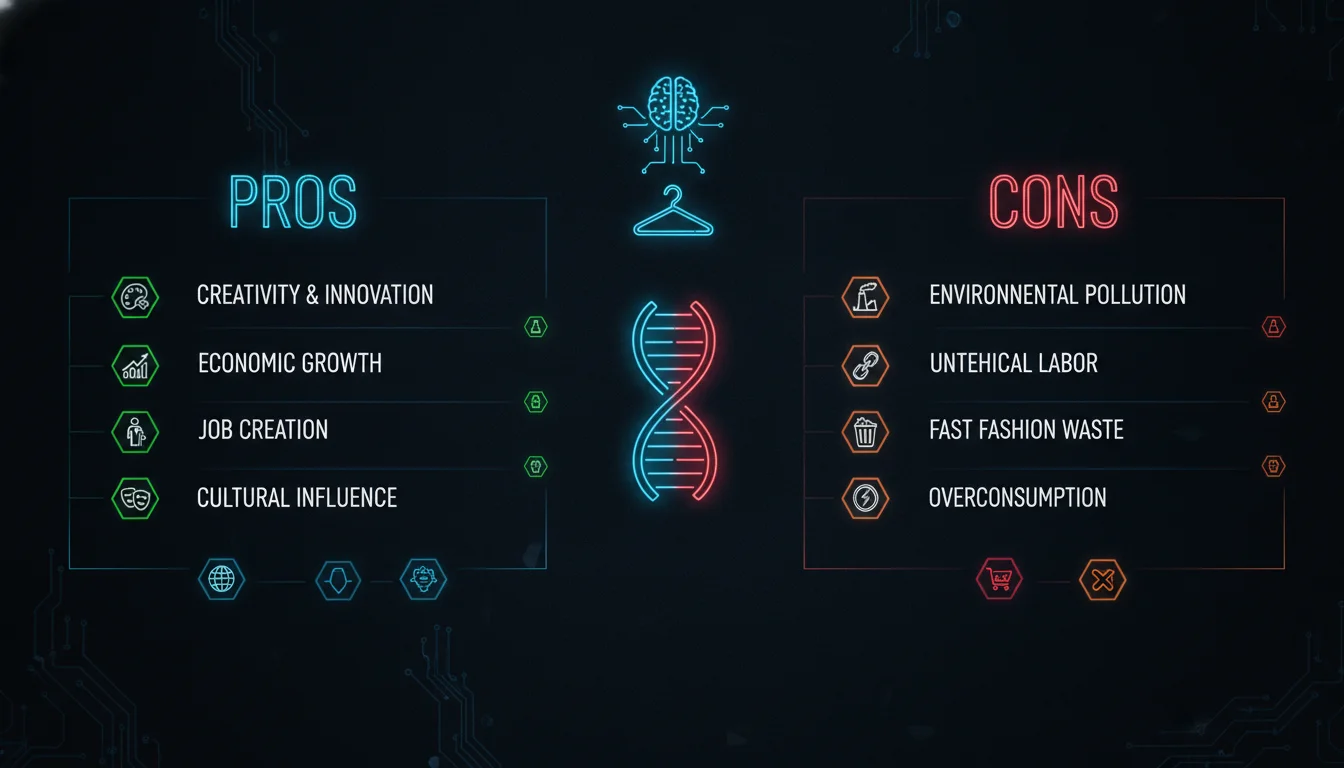
Pros and Cons of the Fashion Industry
The this type of industry creates enormous cultural and economic value, but it carries real costs that are impossible to ignore.
Pros
Massive economic engine: $1.7 trillion in global revenue, supporting millions of jobs across design, manufacturing, retail, and logistics.
Cultural expression: Fashion gives people a language for identity, community, and self-expression, from haute couture to club-ready bodycon.
Innovation driver: The industry pushes advances in materials science, AI-driven design, and sustainable production technology.
Career diversity: Roles span creative, technical, business, and sustainability disciplines, offering entry points for a wide range of skill sets.
Growing sustainability movement: Circular business models, secondhand platforms, and regulatory pressure are pushing the industry toward more responsible practices.
Cons
Environmental damage: The fashion industry contributes 5-10% of global greenhouse gas emissions and is a major source of water pollution.
Labor exploitation: Fast fashion’s low-cost model often depends on low-wage workers in unsafe conditions across global supply chains.
Waste crisis: 100 billion garments produced annually, with the average piece worn only seven times before disposal.
Overconsumption culture: Fast fashion brands releasing 52 micro-collections per year actively encourage impulse buying and rapid discard cycles.
Intellectual property gaps: Fashion design receives weaker IP protection than other creative industries, making it difficult for independent designers to protect original work.
The Environmental Impact of Fashion
“A circular economy is based on the principles of designing out waste and pollution, keeping products and materials in use, and regenerating natural systems.” – Ellen MacArthur Foundation
The fashion industry’s environmental footprint is one of the most urgent issues facing the planet, with emissions, water pollution, and textile waste all reaching critical levels.
Carbon Emissions and Climate Change
The fashion industry accounts for between 5% and 10% of global greenhouse gas emissions, a figure cited by environmental groups and supported by industry research. The energy-intensive production of synthetic fibers like polyester, combined with the global transportation of goods, drives a significant portion of these emissions. If current trends continue, the industry’s carbon footprint could consume a substantial share of the world’s remaining carbon budget by mid-century.
Water Pollution and Waste
Textile production is brutally water-intensive. Producing a single cotton T-shirt can require up to 2,700 liters of water. In many manufacturing countries, untreated wastewater from dyeing and finishing processes is dumped directly into rivers, contaminating ecosystems with lead, mercury, and arsenic. SustainYourStyle reports that 100 billion garments are produced each year, and the average garment is worn only seven times before being discarded. In the EU alone, approximately 11 kilograms of textile waste per capita is generated annually, and at least half of all clothes in a typical wardrobe go unworn.
The Rise of Sustainable Fashion
In response to these pressures, sustainable fashion has emerged as a significant movement. Brands are adopting circular business models, using recycled materials, and offering repair services. Consumers are increasingly turning to secondhand clothing, with platforms like Depop and thredUP experiencing rapid growth. The United Nations’ Fashion Charter provides a framework for companies to commit to science-based emissions targets. These shifts signal a growing awareness that the fashion industry must align with planetary boundaries to survive long-term.
Fast Fashion vs. Sustainable Fashion
Aspect
Fast Fashion
Sustainable Fashion
Production Speed
New collections weekly or monthly (52+ micro-seasons per year)
Two to four seasonal collections, emphasizing timeless design
Materials
Cheap synthetics (polyester, nylon) and conventional cotton
Organic cotton, recycled fibers, low-impact dyes
Labor Practices
Often relies on low-wage workers with poor conditions
High carbon footprint, wastewater pollution, microfiber shedding
Lower emissions, closed-loop water systems, biodegradable packaging
Price
Very cheap ($5-$50 per item)
Higher upfront cost but lower cost-per-wear
Longevity
Designed for short-term use; garments may last 5-10 wears
Built to last for years; often repairable and recyclable
Consumer Mindset
Impulse buying, trend-chasing
Intentional purchasing, wardrobe curation
What Is Fast Fashion?
Fast fashion is a business model that prioritizes speed and low cost, bringing the latest runway trends to mass-market shoppers in a matter of weeks. Brands like Zara, H&M, and Shein release dozens of micro-collections each year, encouraging consumers to buy more and discard quickly. According to SustainYourStyle, some fast-fashion brands put out 52 micro-collections per year, far beyond the traditional two-season calendar. This model has made clothing cheaper, but it has also driven a 400% increase in production compared to just 20 years ago.
The Slow Fashion Movement
Slow fashion is the antithesis of fast. It champions quality over quantity, longer-lasting garments, transparent supply chains, and a deeper appreciation for the craft of making clothes. By investing in fewer, better-made pieces, consumers reduce their environmental footprint and develop a more personal style. The fashion industry is seeing a growing number of small, independent labels, including alternative and nightlife-focused brands like Pretty N Poison, that embody slow fashion principles through made-to-order production and deadstock fabrics.
Consumer Shifts Toward Sustainability
Awareness is driving real change. Among Gen Z and Millennials especially, fashion editors and trend forecasters report a growing willingness to pay more for sustainably made clothing. The secondhand market has flourished, with platforms like Vinted and The RealReal normalizing pre-owned fashion. France’s recent ban on advertising by certain fast-fashion companies, as documented by EBSCO, underscores rising regulatory pressure. These shifts confirm that the fashion industry’s environmental and social practices are no longer optional extras but central to its future.
Fashion and Political Activism
Fashion has always been political. What people wear signals allegiance, protest, and power. From suffragettes wearing white to designers sending political statements down the runway, clothing has served as a form of activism for centuries. As Wikipedia notes, fashion intersects with political activism in ways that are both deliberate and organic, with subcultures using dress to challenge dominant power structures. Today, brands are increasingly expected to take public positions on social issues, and consumers, particularly younger ones, hold them accountable when they don’t.
“There is no beauty in the finest cloth if it makes hunger and unhappiness.” – Mahatma Gandhi, as cited by SustainYourStyle
The 3-3-3 Rule in Fashion
The 3-3-3 rule in fashion is a wardrobe challenge where you select 3 items from your existing closet and style them into 3 different outfits for 3 weeks. It’s a practical tool for building a more intentional wardrobe, reducing overconsumption, and discovering how versatile your existing pieces actually are. Fashion editors and slow fashion advocates use it to push back against the constant pressure to buy new. For nightlife dressing, the rule works differently: three statement pieces, three occasions, infinite attitude.
Careers in the Fashion Industry
The fashion industry offers a wide spectrum of career opportunities, from creative roles to tech-driven positions. Here’s how to start building yours.
Step 1: Identify Your Niche
Decide whether you want to work in design, merchandising, marketing, journalism, sustainability, or technology. The fashion industry is diverse, so clarifying your interest early helps you target relevant education and experience.
Step 2: Gain Relevant Skills and Education
While not always required, a degree from a fashion school like FIT or Central Saint Martins can open doors. Many roles also benefit from skills in digital marketing, data analytics, or CAD software. Internships are critical for building a network and portfolio.
Step 3: Build a Portfolio or Resume
Creatives need a strong portfolio showcasing original designs. Business roles require proven marketing or sales results. Online portfolios and LinkedIn profiles are non-negotiable in a digital-first fashion industry.
Step 4: Network and Apply
Attend fashion events, join industry groups like the US Fashion Industry Association (USFIA), and use platforms like BoF Careers. Competition is fierce. Persistence is not optional.
Design and Creative Roles
Designers, patternmakers, and textile artists form the creative core of the fashion industry. They conceptualize collections, choose fabrics, and oversee production. Digital fashion designers creating virtual garments for the metaverse have also emerged as a distinct and growing career path.
Business and Marketing
Behind every successful label is a team of merchandisers, buyers, supply chain managers, and marketers. The fashion industry relies on data-driven decisions to forecast trends, price products, and drive sales. Roles in public relations and influencer marketing have grown sharply with the rise of social media.
Sustainability and Ethical Roles
As the fashion industry faces increasing scrutiny, roles like sustainability manager, circular economy strategist, and CSR director are in high demand. These professionals work to reduce environmental impact, ensure fair labor practices, and guide brands toward more ethical models.
The Future of Fashion
Technological Innovations
Technology is set to transform the fashion industry further. AI-driven design tools, 3D knitting, and blockchain for supply chain transparency are gaining traction. Digital fashion, clothing that exists only in virtual spaces, could become a major market as the metaverse expands. These innovations promise to make the industry more efficient and significantly less wasteful.
Regulatory Changes
Governments are beginning to hold the fashion industry accountable. The European Union is developing extended producer responsibility (EPR) schemes that require brands to pay for textile waste management. The New York Fashion Act, if passed, would mandate that large fashion companies disclose their environmental and social due diligence. Such regulations could reshape global supply chains and force a reckoning with decades of unchecked production.
The Role of Alternative and Nightlife Fashion
While mainstream fashion chases mass trends, alternative fashion, rooted in subcultures like punk, goth, rave, and club scenes, is gaining real visibility. Brands that cater to bold self-expression and nightlife are proving that sustainability and edgy design can coexist. Labels offering festival wear or party-ready corsets and bodycon dresses increasingly use eco-friendly materials and small-batch production. This niche doesn’t just challenge the homogeneity of the fashion industry. It champions individuality and ethical consumption at the same time. As consumers seek uniqueness and meaning in their clothing, alternative fashion may well steer the broader industry toward more authentic and responsible practices.
At Pretty N Poison, we live in that space. The Pretty Edit brings soft, romantic energy. The Poison Edit goes darker, sharper, more dangerous. The Duality collection holds both truths at once. And the Night Ritual is exactly what it sounds like: going-out essentials built for women who dress with intention. Explore the full range at prettynpoison.com and discover your duality.
Frequently Asked Questions
What is the fashion industry?
The fashion industry is the global business of designing, manufacturing, and selling clothing and accessories. It spans haute couture, ready-to-wear, and mass-market apparel, and generates trillions of dollars annually across design, production, retail, and digital channels.
How big is the fashion industry?
In 2021, the global fashion industry generated approximately $1.7 trillion in revenue, according to FashionUnited and Euromonitor International. McKinsey’s State of Fashion 2017 report noted that if the fashion industry were a country, its GDP would rank seventh worldwide.
What are the main environmental impacts of the fashion industry?
The fashion industry contributes 5-10% of global greenhouse gas emissions, pollutes waterways with toxic chemicals from dyeing processes, and produces over 100 billion garments per year, most of which end up in landfills or incinerators. The EU alone generates approximately 11 kilograms of textile waste per capita annually.
What is the difference between fast fashion and sustainable fashion?
Fast fashion emphasizes cheap, trend-driven clothing produced rapidly, often with poor labor and environmental records. Sustainable fashion prioritizes ethical production, durable materials, and circular models designed to minimize harm and extend garment life.
What is the 3-3-3 rule in fashion?
The 3-3-3 rule is a wardrobe challenge where you choose 3 existing pieces and create 3 different outfits to wear over 3 weeks. It encourages intentional dressing, reduces overconsumption, and helps you get more out of what you already own.
What are five careers in the fashion industry?
Five key careers in the fashion industry include fashion designer, merchandiser, sustainability manager, fashion marketer, and digital fashion designer. Each requires a different skill set, but all benefit from a strong understanding of trends, consumer behavior, and the industry’s evolving landscape.
What are fashion capitals?
Fashion capitals like Paris, New York, and Milan are cities that exert major influence over global trends and house leading design houses, fashion weeks, and industry headquarters. Tokyo, London, and Los Angeles are recognized as second-tier fashion centers with strong independent design scenes.
Brown dresses for women are the boldest neutral of 2026: dark enough to carry an edge, warm enough to flatter every skin tone, and versatile enough to own any room from a rooftop cocktail hour to an underground club night.
Key Takeaways
for women are a year-round power neutral, flattering all skin tones when you choose the right shade from tan to espresso.
Silhouette is everything: mini, midi, maxi, bodycon, and slip styles each suit different occasions and body shapes.
Accessorize with gold jewelry, tortoiseshell accents, and tonal shoes for a cohesive, elevated look.
Shop across budget, mid-range, and premium tiers to find a brown dress that fits your aesthetic and your wallet.
Brown carries a quiet confidence, according to Böhme’s styling team, that outsells louder colors across weddings, work, and weekend looks.
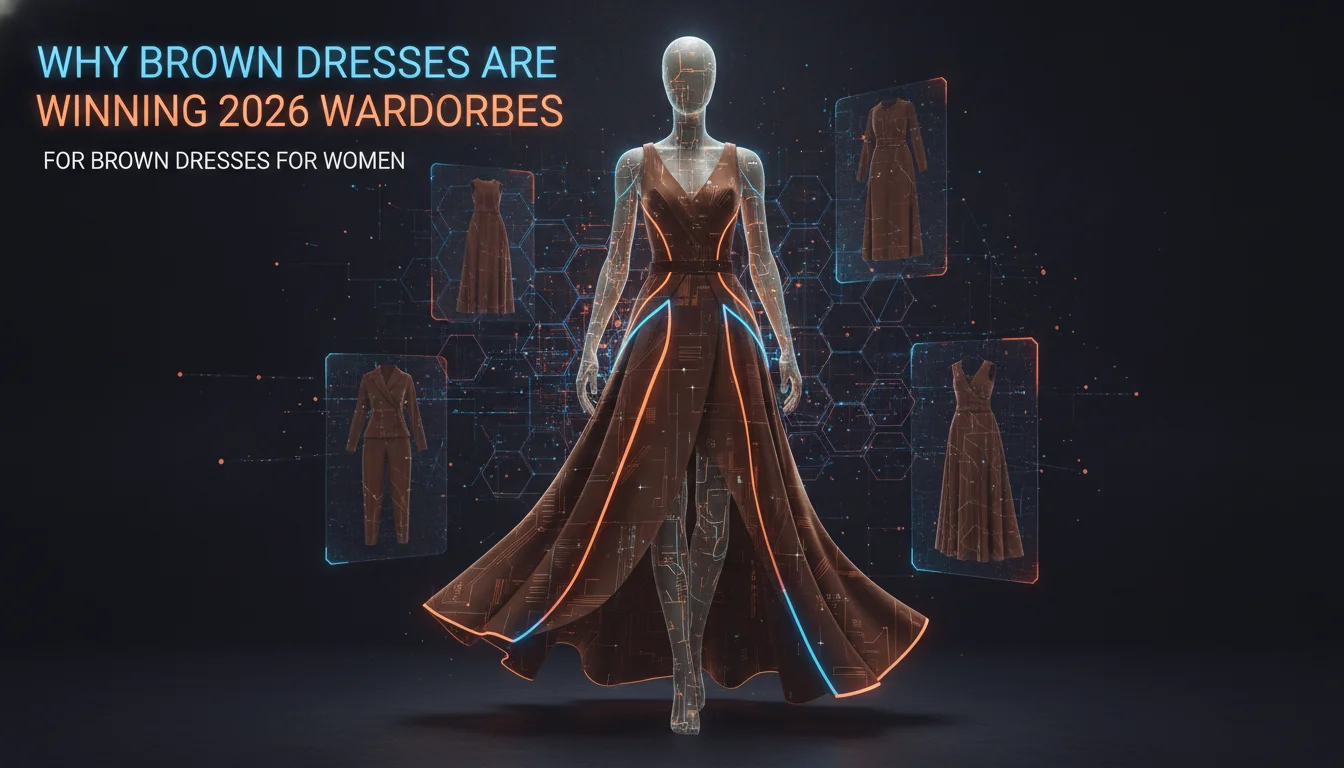
Why Brown Dresses Are Winning 2026 Wardrobes
Brown dresses for women have claimed their place as a year-round power player. According to Pinterest trend data, brown dress searches draw over 39,000 monthly saves from users hunting for inspiration. Böhme’s styling team notes that brown carries a quiet confidence that outsells louder colors, making it a favorite for weddings, work, and weekend looks. The secret is its versatility: chocolate, mocha, camel, and taupe all act as a soft backdrop for bold accessories or layered textures.
At Pretty N Poison, we see brown as a canvas for self-expression. Whether you’re into corset details, sheer panels, or asymmetrical cuts, a well-chosen brown dress lets your silhouette speak while keeping the tone grounded. As of 2026, expect brown dresses dominating nightlife, from underground warehouse parties to rooftop cocktail hours.
“Brown is the color that never has to try. While bolder shades compete for attention, brown dresses carry a quiet confidence that works across every setting.” – Böhme Styling Team
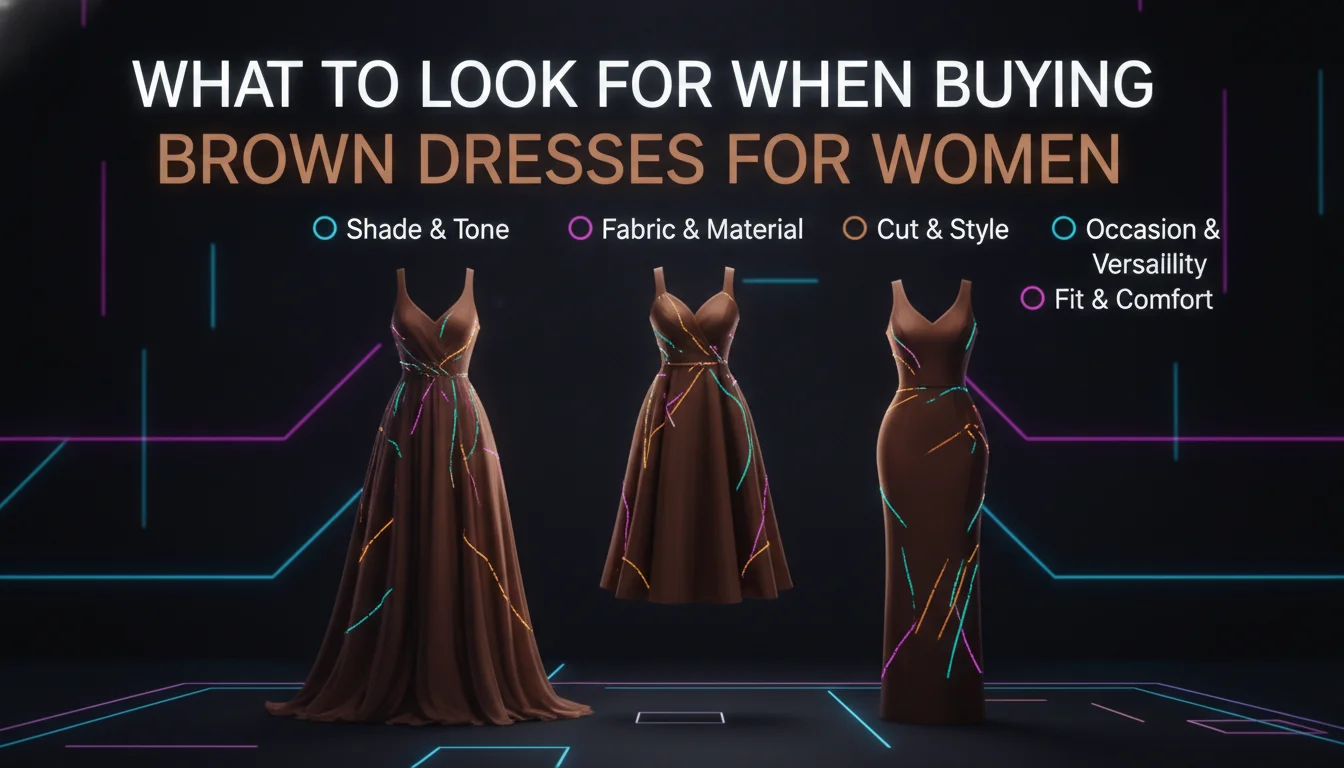
What to Look for When Buying Brown Dresses for Women
Choosing the perfect brown dress goes beyond loving the color. These criteria ensure you invest in a piece that feels good, looks incredible, and holds up through every night out.
Step-by-Step Buying Process
Step 1: Define the occasion. Will this be a day-to-night essential or a special-event star? Casual brunch calls for a flowy midi, while a club night demands a body-hugging mini.
Step 2: Find your shade. Warmer complexions glow in camel and cognac; cooler skin tones pop in mocha and taupe. A universal chocolate brown works across nearly all.
Step 3: Pick a silhouette. Consider your body shape and comfort. A-line and fit-and-flare styles add balance, while slip and bandage dresses create a sleek line.
Step 4: Check materials and construction. Look for breathable, durable fabrics like organic cotton, Modal, or recycled polyester. Double-stitched seams and quality zippers signal longevity.
Step 5: Assess brand ethos. If ethics matter to you, prioritize brands that use eco-friendly dyes, ethical labor, and deadstock fabrics, like our own Pretty N Poison collection.
Materials That Matter
Fast fashion floods the market with polyester brown dresses that pill after three washes. Instead, seek out natural and recycled fibers: Tencel, cupro, and organic cotton drape beautifully and breathe. For evening wear, recycled satins and deadstock lace offer that same sultry look without the environmental guilt. At Pretty N Poison, our brown party dresses use a mix of reclaimed fabrics and low-impact dyes to keep your look sharp and sustainable.
Price Range Expectations
Brown dresses for women span a wide pricing spectrum. Below is a quick reference based on competitor ranges observed in 2026:
Budget ($20–$70): Trend-driven styles from brands like PrettyLittleThing, where sale pricing regularly slashes original prices by 60% or more.
Mid-Range ($65–$150): Better construction and fabrics from Princess Polly, American Threads, and Böhme. Princess Polly’s bandage minis sit around $75; these balance quality with affordability and are ideal for frequent wear.
Premium ($150–$348+): Investment pieces from Anthropologie, where styles like the Hutch Corset Pleated Tulle Fit and Flare Midi reach $348, using luxe materials and unique design details that last for years.
Size and Fit Considerations
Always check size charts. Different brands interpret sizing differently. Princess Polly and Böhme offer regular and petite options, while Lulus provides an extensive size range up to 3X. When in doubt, read reviews for real talk on how a dress stretches, shrinks, or runs small. For alternative silhouettes with cut-outs and corsetry, consider going a size up for a more comfortable, layered look.
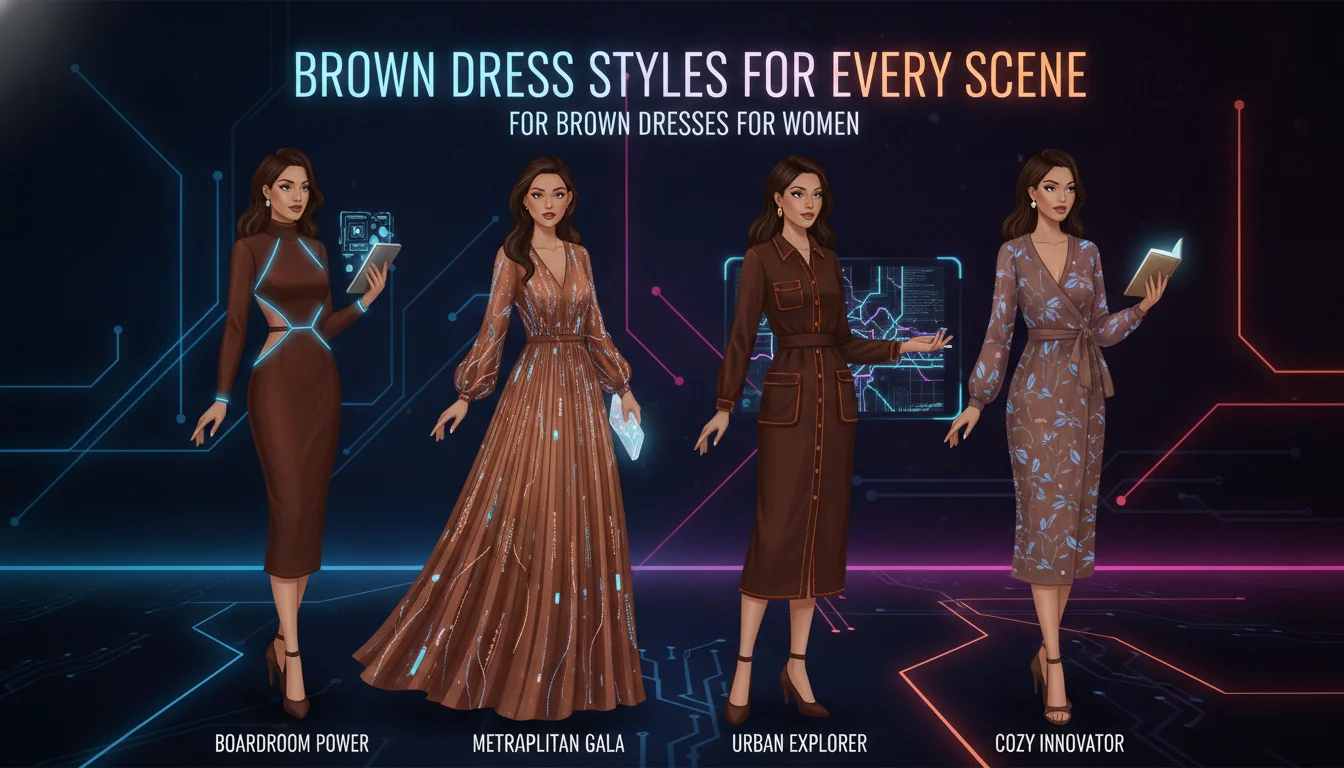
Brown Dress Styles for Every Scene
Brown dresses for women come in every silhouette imaginable, and the cut defines the vibe. Here’s your cheat sheet.
Mini Dresses: The After-Dark Hero
A brown mini dress brings edge to any night out. Look for details like lace overlays, faux leather panels, or asymmetric hems. Pair with chunky boots and a leather jacket for a grunge-luxe feel, or strappy heels and gold chains for a sleek dinner date. PrettyLittleThing offers micro-minis with corset lacing, while Princess Polly’s bandage minis hug curves in all the right places.
Midi Dresses: The Day-to-Night Chameleon
Midi lengths strike the perfect balance between polished and easy. A knit brown midi with a slit walks you from office to happy hour without missing a beat. For a more alternative take, choose a bias-cut slip midi with delicate lace trim: layer a graphic tee underneath or a harness over top. Anthropologie’s Maeve label carries square-neck ruched knits that look expensive, while Böhme’s earthy midis feel effortlessly grounded.
Maxi Dresses: Drama and Comfort
Nothing says statement quite like a brown maxi dress. Satin or velvet versions bring formal drama, while lightweight crinkle fabrics work for beachy vibes. For an edgy twist, scout designs with thigh-high slits, open backs, or unexpected cutouts. American Threads and Princess Polly both do affordable satin maxis that rival designer looks. Pretty N Poison’s maxi collection often features recycled chiffon and power mesh for a darker aesthetic.
Bodycon and Bandage: Sculpting the Curve
Body-hugging brown dresses are made for nights when you want to feel untouchable. Opt for double-layered stretch fabrics that smooth without suffocating. The bandage dress, popularized by Hervé Léger, remains a staple, and plenty of mid-range brands now offer versions that still deliver the compression. Look for princess seams and invisible zippers that don’t warp over time.
Brand
Style Focus
Price Tier
Best For
PrettyLittleThing
Trend-driven, club-ready, micro-minis
Budget (from $20)
One-season statements, bold nights out
Princess Polly
Cute, feminine, occasion wear
Mid ($65–$99)
Birthdays, brunches, flirty daytime looks
Böhme
Earthy, sophisticated, boho-lite
Mid ($70–$130)
Work events, weddings, polished casual
American Threads
Affordable, trendy, college-age
Mid ($80–$100)
Sorority formals, game day, vacation
Anthropologie
Premium, artistic, high quality
Premium ($78–$348+)
Investment pieces, unique silhouettes
Pretty N Poison
Edgy, alternative, sustainable
Mid ($80–$130)
Nightlife, self-expression, eco-conscious
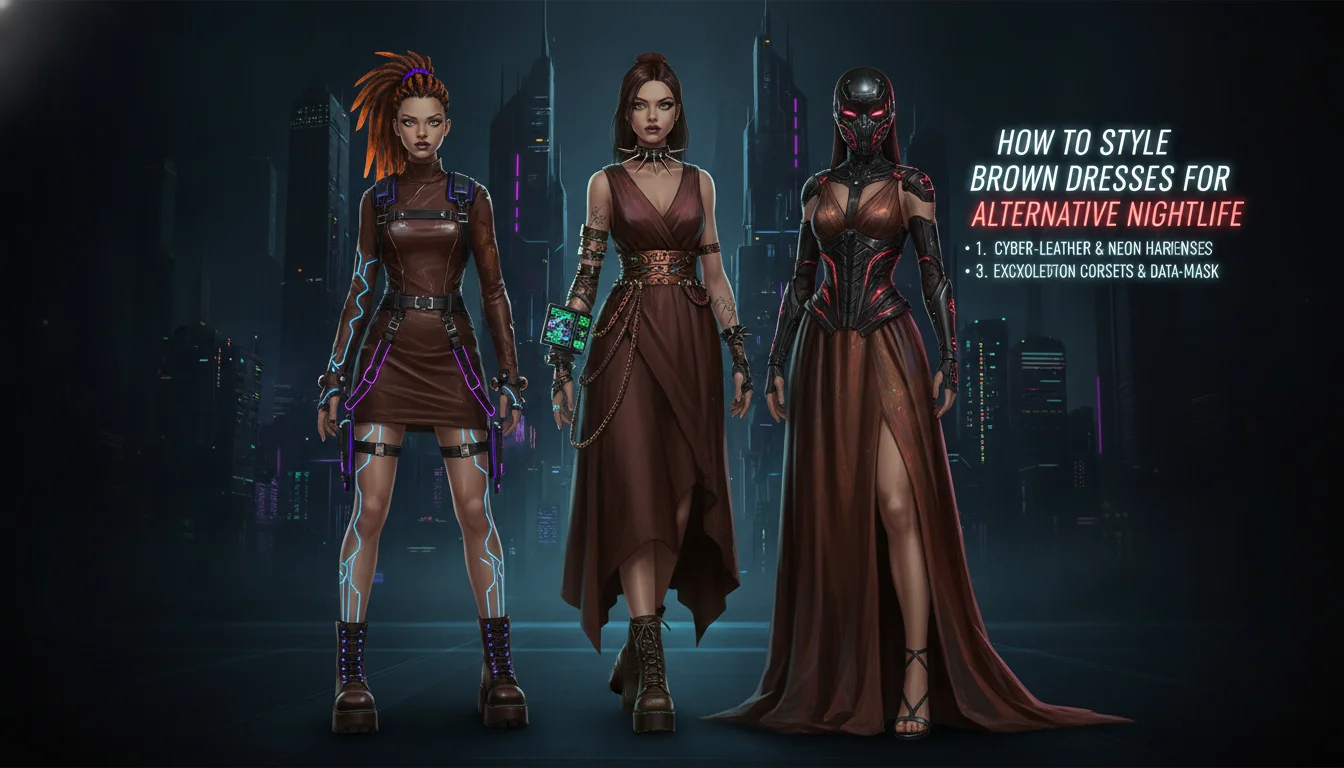
How to Style Brown Dresses for Alternative Nightlife
Brown’s magic is its quiet backdrop that lets your styling choices do the talking. Here are three outfit formulas that ditch the boring and embrace the bold.
Outfit Idea 1: The Leather-Clad Rebel
Dress: Chocolate mini bodycon with cutout waist. Layers: Cropped black leather moto jacket and a silver chain waist belt. Shoes: Heavy platform combat boots with chunky socks peeking out. Accessories: Studded choker, multiple ear cuffs, and a mini backpack in black patent.
Outfit Idea 2: The Gothic Romantic
Dress: Satin slip maxi in espresso with delicate lace trim. Layers: A sheer mesh turtleneck underneath for a Victorian twist. Shoes: Strappy stilettos with ankle harnesses. Accessories: A velvet choker with a pendant and silver rings stacked on every finger.
Outfit Idea 3: The Minimalist Edge
Dress: Tan midi with asymmetric hem and one-shoulder neckline. Layers: A thin black nylon harness worn over the dress. Shoes: Square-toe heeled mules in black. Accessories: A single bold ear cuff and a micro bag in a contrasting metallic.
Pros and Cons of Brown Dresses for Women
Brown dresses for women offer serious style range, but like any wardrobe investment, they come with trade-offs worth knowing before you buy.
Pros
Universally flattering: Every skin tone has a brown shade that works, from camel for warm complexions to mocha and taupe for cooler ones.
Year-round wearability: Lighter tans carry summer energy; deep chocolates and espresso tones own fall and winter nights.
Styling versatility: Brown acts as a neutral canvas, pairing with gold, black, white, and metallics without clashing.
Occasion range: According to Böhme’s styling team, brown dresses work across casual everyday wear, brunch, work, weddings, and evening events.
Trend longevity: Unlike neon or novelty prints, brown is a perennial color that won’t look dated next season.
Cons
Shade sensitivity: The wrong brown can wash out certain skin tones if you don’t match warm or cool undertones carefully.
Fading risk: Deep chocolate and espresso tones can fade to a murky shade without proper cold-water washing and shade drying.
Limited contrast options: Brown-on-brown tonal dressing requires a confident eye; without the right accessories, the look can fall flat.
Care and Maintenance: Keeping Your Brown Dress Vibrant
Brown can fade to a murky shade if mistreated. Follow these steps to protect your investment.
Always check the label. Silk and wool blends demand dry cleaning; cotton and polyester blends can often handle a gentle machine wash.
Turn inside out before washing to reduce surface friction that dulls the color.
Use cold water and mild, eco-friendly detergent. Hot water breaks down fibers and encourages bleeding.
Avoid the dryer. Heat is the enemy of dark hues; lay flat or hang to dry in shade to prevent UV damage.
Store carefully. Fold knits to prevent stretching, and hang structured pieces on padded hangers to maintain shape.
If your dress picks up a slight sheen from wear, a steamer will refresh it without chemicals. For liquid spills, common at parties, blot immediately with a damp cloth and treat with a stain remover safe for the fabric type.
Where to Shop: Navigating the Sea of Choices
With brown dresses for women now a mainstream staple, finding one that matches your aesthetic and ethics can feel overwhelming. The comparison table above breaks down the main players by budget and vibe. For alternative shoppers, look beyond the big names. Small indie brands and vintage sellers often carry unique brown dresses with built-in character: think 90s slip dresses or bias-cut velvets. At Pretty N Poison, we focus on sustainable partywear, so every brown dress in our collection is made with deadstock or recycled materials, ensuring you can dance hard without harming the planet.
“Each brown dress is a statement, a mood, a confident stride into the spotlight. Rewear on repeat – because why wouldn’t you?” – PrettyLittleThing editorial team
Brown dresses for women work for casual everyday wear, brunch, work, weddings, holidays, and evening events. Lighter tones suit daytime and warm weather, while deeper shades like chocolate and espresso carry evening and formal energy.
What skin tone looks best in brown?
Every skin tone has a flattering brown shade. Warmer complexions glow in camel, cognac, and warm tan tones. Cooler complexions pair beautifully with mocha, taupe, and cool-toned chocolate. According to Böhme’s styling team, a mocha brown dress tends to flatter the widest range.
What shoes should I wear with a brown dress?
Tan and brown leather shoes create a tonal, cohesive look. White shoes offer a fresh contrast for summer. Gold and metallic heels dress up brown dresses for women heading to evening events. Black shoes work with darker chocolate and espresso tones.
Can I wear brown to a wedding?
A brown dress in a rich chocolate, mocha, or coffee tone is an elegant wedding guest choice, particularly for fall and winter ceremonies. Pair with polished accessories and heeled shoes to match the formality of the occasion.
How do I accessorize a brown dress for a night out?
Gold jewelry amplifies the warmth of brown, while silver and black metal accents add an edgy contrast. Tortoiseshell accessories, leather harnesses, and statement belts can transform a simple brown dress into a club-ready look that commands attention.
Are brown dresses only for fall?
Brown works year-round. Lighter shades like tan and camel are warm-weather staples. Deeper tones like chocolate and espresso are fall and winter signatures. A sleeveless or strapless brown dress in a light fabric is a strong warm-weather choice.
How do I find a sustainable brown dress?
Look for brands that use organic, recycled, or deadstock materials and maintain transparent supply chains. Pretty N Poison creates brown dresses from reclaimed fabrics and eco-friendly dyes, perfect for the eco-minded partygoer who refuses to compromise on style.
Store dresses for women are retail-ready styles spanning every silhouette, from bodycon club cuts to floor-length gowns, available at price points from $5.99 to nearly $500. We’ve mapped the best retailers, the boldest trends, and the styling moves that separate a dress from a look.
Key Takeaways
Budget to luxury: Rainbow offers for women from $5.99 while Dressbarn stocks gowns up to $469.95.
Size inclusivity matters: Walmart carries sizes 0–26W; Dressbarn offers Missy, Petite, and Plus lines.
Sustainable materials are rising: Look for Tencel, organic cotton, or recycled polyester at boutiques like The Mint and Red Dress.
Nightlife styling is everything: Bodycon for clubs, maxi for drama, layering for edge.
Care extends garment life: Machine wash cold, line dry, and store on padded hangers.
Dillard’s runs sales up to 65% off select styles, making premium brands accessible.
“The key to nailing store-bought evening wear is customization. Adding a harness, a chunky chain, or a corset belt transforms a basic dress into a statement piece,” says Rei Nakamura, stylist for alternative runway shows.
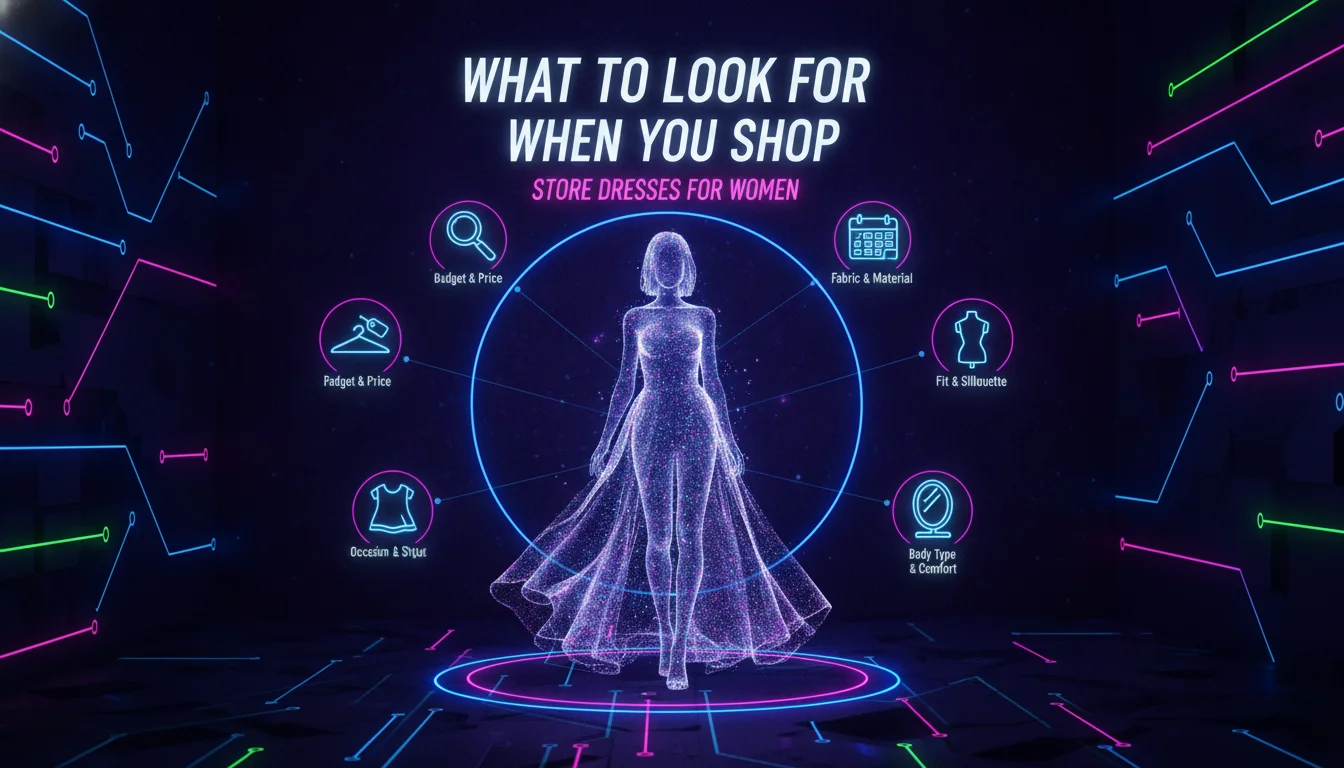
What to Look For When You Shop Store Dresses for Women
The best this type of women balance fabric quality, silhouette, and occasion versatility. Knowing what to prioritize before you click “add to cart” saves you from a closet full of regret and a bank account full of returns.
Fabric and Sustainability
A dress’s fabric decides its drape, comfort, and eco-footprint. Sustainable partywear refers to garments made from eco-friendly materials like Tencel, organic cotton, or recycled polyester, designed to reduce environmental impact. At mass retailers, polyester dominates. Dressbarn relies heavily on it, while Rainbow mixes blends for affordability. Boutiques like The Mint and Red Dress increasingly stock Tencel, a lyocell fiber derived from wood pulp, known for its silky drape and closed-loop production process. Check product descriptions for certifications like OEKO-TEX or GOTS, even in fast fashion. Walmart now lists some organic cotton options among its 1,000+ dress styles, flagged with “Sustainable” tags. According to the Fashion Revolution movement, supply chain transparency is the foundation of ethical consumption.
Fit and Silhouette
Silhouette is everything. A bodycon dress hugs the body like a second skin, typically constructed with spandex for stretch. A shift dress hangs straight from the shoulders, a vintage-inspired staple for cocktail hours. Maxi dresses are floor-length styles that elongate the silhouette and work for both boho beach days and red-carpet moments. Sizing ranges widely across retailers: Walmart stocks sizes 0–26W, ensuring plus-size shoppers find clubwear that actually fits, while Dressbarn offers Missy, Petite, and Plus lines across its $49–$470 range. Rainbow’s junior cuts run smaller, so review their size chart before adding to cart.
Occasion and Versatility
One dress, multiple nights. Rainbow’s sleeveless smocked midi dress (originally $24.97, on sale for $18.72) transitions from a patio party to a neon-lit dance floor with the right accessories. Dressbarn’s Vienna Maxi Dress ($139.95) doubles as a wedding-guest option or an avant-garde layering piece. For day-to-night agility, choose midi lengths with interesting details like cutouts (Rainbow’s Cutout Tie Front Puff Sleeve Mini Dress at $5.99) or hardware (Dressbarn’s Jersey Side Draped Dress with Hardware, $79.95).
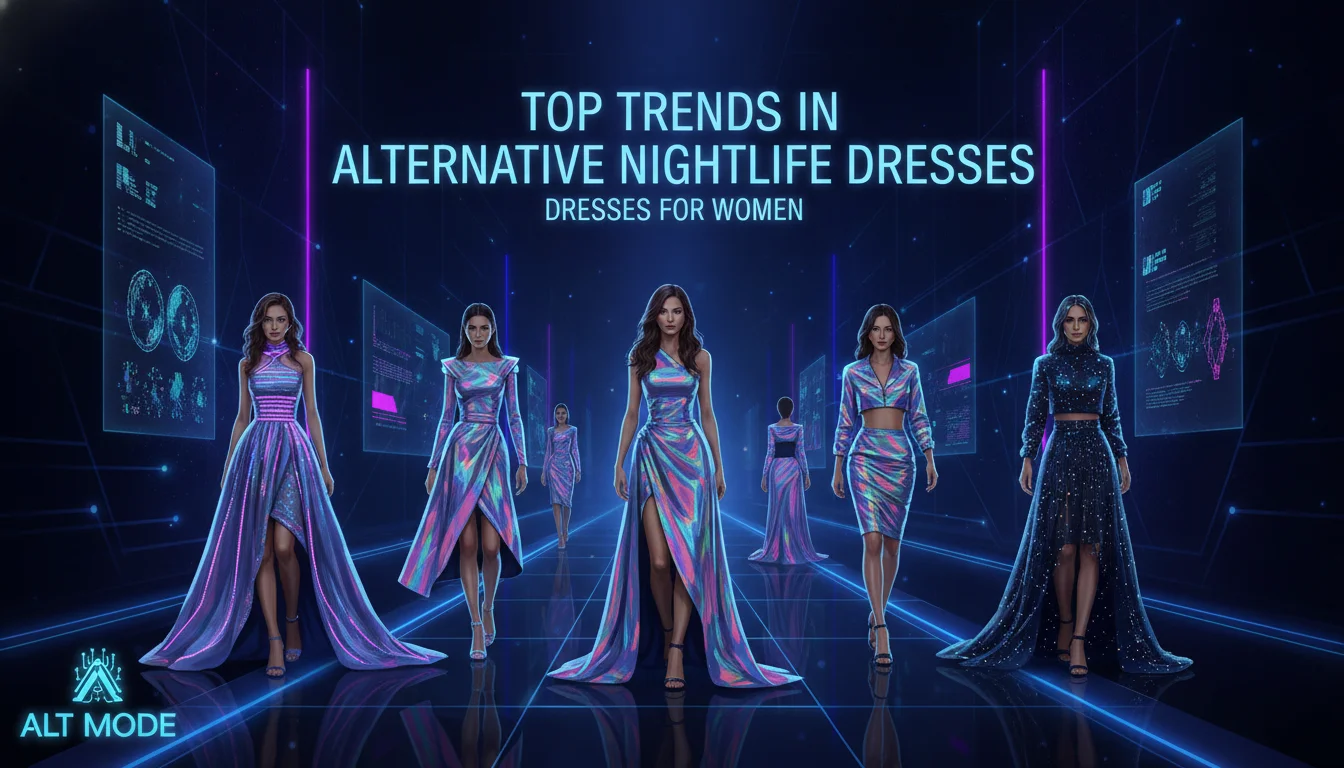
Top Trends in Alternative Nightlife Dresses
Alternative nightlife dresses in 2026 are defined by texture contrast, hardware details, and silhouettes that refuse to apologize. According to fashion editors at Vogue and ELLE, the current cycle rewards boldness over minimalism, especially after dark.
Bodycon with Edge
Bodycon isn’t just basic. Look for asymmetrical cutouts, mesh panels, or faux-leather accents. Rainbow’s Mixed Media Faux Leather Midi Dress ($28.97) merges soft fabric with aggressive texture. Pair with chunky platform boots and a harness belt to own the crowded floor. The Almost Famous Textured Knit O Ring Detail Halter Mini Dress ($12.72) adds bondage-inspired hardware, a staple in alt-fashion circles. TikTok trend reports from 2025–2026 consistently show faux-leather and O-ring details among the top-performing nightlife aesthetics.
Maxi Drama
Maxi dresses demand attention. Dressbarn’s Blossoming Beauty Mesh Evening Gown ($469.95) drips with gothic romance, while Rainbow’s Zebra Print Mesh Cowl Halter Neck Maxi Dress (under $15) brings animal magnetism at a fraction of the price. Sustainable twist: Look for lyocell-blend maxis at boutiques to reduce your nightlife footprint. Maxi length pairs with stacked platform sandals or combat boots for an anti-establishment edge that runway data from recent seasons confirms is still very much alive.
Mini and Midi Statements
Mini dresses from Rainbow (like the $8.48 Polka Dot Lace Trim Cami Mini Dress) channel pure ’90s rave energy. Midi lengths serve elevated versatility: The Mint’s Worth Noting Brown Striped Midi Dress ($72) shifts from brunch to basement rave with a graphic sock boot. Layering a mesh top underneath a midi slip dress adds a DIY punk spirit, a trick pulled straight from underground club scenes. This is where this kind of for women stop being “store-bought” and start being yours.
Comparison of Top Retailers for Store Dresses for Women
Not all retailers are built the same. Here’s how the major players stack up across price, size, and nightlife suitability.
Retailer
Price Range
Size Inclusivity
Best For
Unique Perk
Dressbarn
$49–$470
Missy, Petite, Plus
Formal & Cocktail
BOGO 50% off
Rainbow
$6–$29
Juniors sizes
Trendy Nightlife
Ultra-affordable; 25–50% off sales
The Mint
$52–$116
XS–XL, 1X
Boutique Casual
10% off first order
Red Dress
$54–$128
Missy
Vacation & Events
Free shipping over $100
Walmart
$10–$50+
0–26W
Everyday & Plus Size
1,000+ styles
Dillard’s
$50–$500
Standard, Plus, Petite
Premium Brands
Up to 65% off sale
Sources: Retailer websites accessed July 2025; prices and offers subject to change.
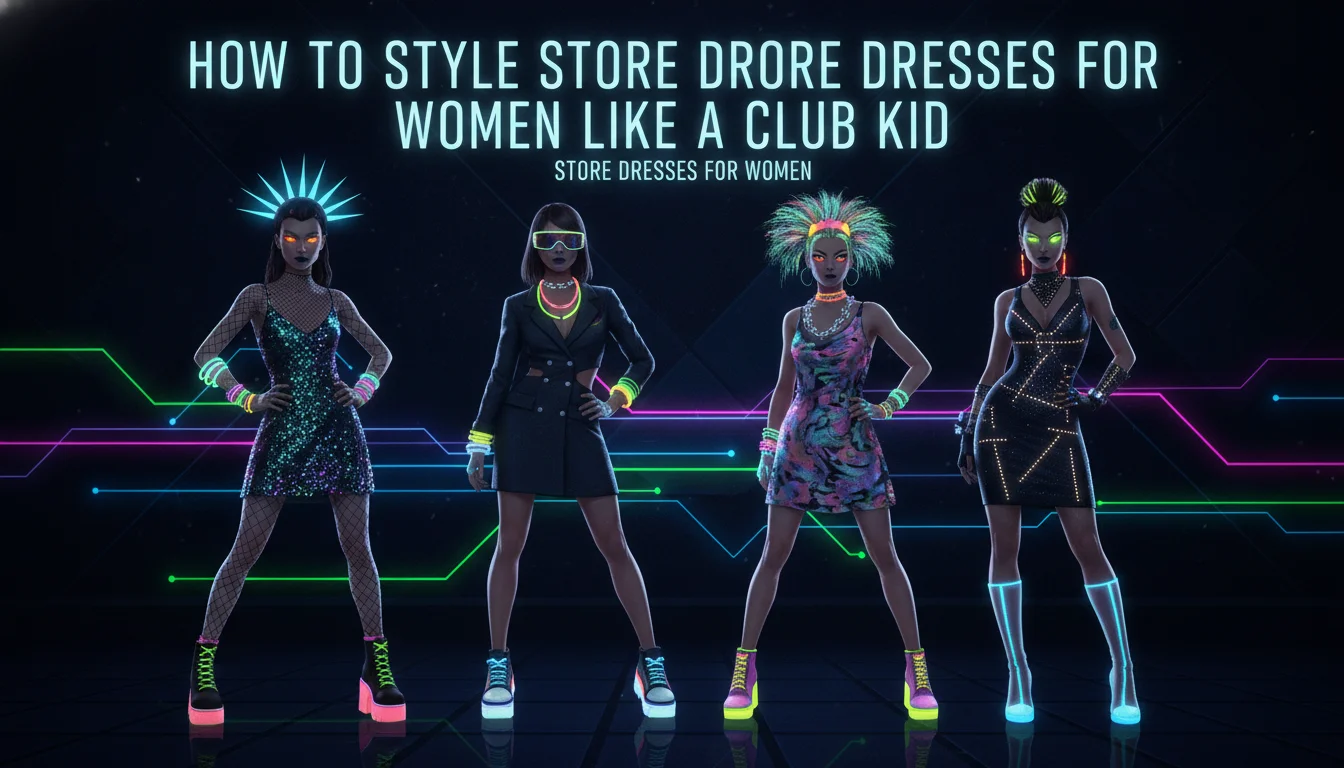
How to Style Store Dresses for Women Like a Club Kid
Styling the dresses for women into nightlife-ready looks is a four-step process that starts with silhouette and ends with accessories that make people stare. No basic advice here. Just moves that work.
Step 1: Choose Your Foundation
Start with a statement silhouette. A bodycon hugs curves for maximal impact. Rainbow’s Geometric Print Side Ruched Tube Dress ($16.99) has built-in drama. For a looser canvas, try a shift or babydoll mini and build the edge through layers and hardware instead.
Step 2: Add Cultural Layers
Layering is the soul of subculture style. Throw an oversized fishnet top under a tank dress, or a distressed denim jacket over a floral maxi. The Mint’s Feeling Your Best Cream Tiger Babydoll Dress ($60) becomes club-ready with a black leather corset belt and studded choker. This is the move that separates a dressed-up woman from a woman with a point of view.
Step 3: Accessorize with Abandon
Chunky hardware changes everything. Chain belts, platform goth boots, and oversized safety-pin earrings push a dress from mall to mosh pit. Red Dress’ Makes Sense To Me Gold Curved Sculptural Drop Earrings ($24) add a futuristic gleam to even the most minimalist silhouette. Don’t underdress the accessories.
Step 4: Weather-Proof the Look
For cooler nights, layer a vinyl trench or a cropped faux-fur jacket over your dress. Dressbarn’s 2Pc Jacket Dress with Detachable Necklace ($69.97, originally $99.95) does double duty as a mod set that handles both the venue and the walk from the cab. Practical and poisonous.
Sustainable Partywear: A New Wave in Dress Shopping
Alternative fashion and sustainability are colliding in real time. Shoppers increasingly demand eco-conscious rave wear, and the market is finally responding. Boutiques like The Mint and Red Dress curate cotton and linen blends, while big-box stores expand organic collections. The Ellen MacArthur Foundation advocates for circular fashion systems, pushing brands to design for recyclability from the first sketch.
What to Look For
Seek certifications: OEKO-TEX guarantees no harmful chemicals in the finished fabric, and GOTS ensures organic fiber status throughout the supply chain. Fabric content matters beyond the label. Tencel uses significantly less water than conventional cotton, while recycled polyester repurposes plastic bottles that would otherwise sit in landfill. Read product descriptions carefully. Walmart flags eco-items with “Sustainable” tags, making it easier to filter 1,000+ styles down to conscious choices.
Styling Sustainably
Secondhand is the ultimate green move. Pair a new organic cotton dress from The Mint (priced $52–$116) with vintage finds: a ’90s leather jacket from a thrift shop or pre-loved platform boots. Rent for one-offs: Dress rental platforms let you borrow a $400+ sequined gown for roughly $50–$80, cutting closet waste without cutting the drama. As of 2026, rental fashion has moved from niche to mainstream, with Who What Wear citing it as one of the fastest-growing segments in women’s occasion wear.
Dress Codes Decoded: What to Wear and When
women cover every dress code on the spectrum, but knowing which silhouette fits which occasion keeps you from showing up overdressed to a dive bar or underdressed to a rooftop cocktail party.
Black-Tie and Formal Events
Black-tie calls for floor-length or tea-length gowns. Dressbarn’s Luminous Sequin Lace Evening Gown ($249.95) and Blossoming Beauty Mesh Evening Gown ($469.95) both clear the bar. Dillard’s premium brand selection, often discounted up to 65% off during sale events, is worth checking for designer-adjacent options at accessible prices. The rule: structured, polished, and intentional.
Cocktail and Semi-Formal
Cocktail dress code sits between formal and casual, typically landing at knee to midi length. Dressbarn’s Vienna Maxi Dress ($139.95) works here, as does anything from Red Dress in the $54–$128 range with clean lines and elevated fabric. This is where the Poison Edit lives: pretty enough for the venue, dangerous enough to be remembered.
Club, Rave, and Nightlife
No rules. Maximum impact. Rainbow’s $6–$29 range delivers bodycon, mesh, and faux-leather options that survive a full night on the floor. Pair with hardware accessories and platform boots. The only dress code here is: make them look twice.
Care and Maintenance for Your Store Dresses for Women
store dresses last longer when you treat the fabric right. A $12 Rainbow mini and a $250 Dressbarn gown both deserve proper care, just different versions of it.
Washing and Drying
Machine wash cold is the standard care instruction for polyester blends, preventing shrinkage and color fade. Turn dresses inside out to protect surface embellishments like sequins or lace trim. Line dry whenever possible. Heat damages elastic fibers, shortening the life of bodycon fits. For silk-lined cocktail dresses from Dillard’s, dry clean only to preserve the sheen and structure.
Storage and Organization
Use padded hangers for structured shoulders and velvet hangers to prevent slinky slips from sliding off. Fold knits and jersey dresses to avoid stretching at the shoulders. Store leather and faux-leather accents away from direct sunlight to prevent cracking. A garment bag shields statement pieces like Dressbarn’s Luminous Sequin Lace Evening Gown ($249.95) from dust and snags between wears.
“Proper storage is where most women lose money on fashion. A $30 dress stored correctly outlasts a $200 dress thrown on the floor,” notes fashion care specialist and wardrobe consultant Dana Voss, whose clients include touring musicians and nightlife performers.
Pros and Cons
Shopping for women comes with real advantages and real trade-offs. Know both before you buy.
Pros
Wide price range: Options from $5.99 (Rainbow) to $469.95 (Dressbarn) mean every budget is covered.
Size inclusivity: Retailers like Walmart (0–26W) and Dressbarn (Missy, Petite, Plus) serve a broad range of bodies.
Trend speed: Fast-fashion retailers refresh this type of women weekly, keeping nightlife looks current.
Accessibility: Physical stores plus online shopping means you can try before you buy or get next-day delivery.
Styling versatility: One dress, styled three ways, covers club night, cocktail party, and brunch.
Cons
Fabric quality varies wildly: Budget retailers often use lower-grade polyester blends that pill or fade after a few washes.
Sizing inconsistency: Junior sizing at Rainbow versus Missy sizing at Dressbarn means you can’t trust a single size number across retailers.
Environmental cost: Fast-fashion this kind of for women contribute to textile waste unless you actively seek sustainable options.
Limited alteration support: Off-the-rack fits aren’t tailored to your body. Budget for minor alterations on anything above $100.
From $5.99 Rainbow minis to $469.95 Dressbarn gowns, the world of the dresses for women holds something for every body, budget, and subculture. Prioritize fit, fabric, and versatility. Then infuse the styling moves above to stand out. Whether you’re at a warehouse rave or a darkwave concert, your dress is a canvas. Make it say something worth hearing.
Where can I find the cheapest store dresses for women?
Rainbow offers store dresses for women as low as $5.99, with regular sales running 25–50% off. Walmart also carries many styles under $15, with over 1,000 options available online.
How do I know my size when shopping for store dresses for women online?
Check each retailer’s size chart before ordering, since sizing varies significantly. Rainbow runs junior cuts, Dressbarn offers Missy and Plus, and Walmart covers sizes 0–26W. Measure your bust, waist, and hips and compare against the specific chart.
Are sustainable party dresses worth the higher price?
Yes. Sustainable store dresses for women made from Tencel or organic cotton typically last longer and hold their shape better than fast-fashion blends. The cost-per-wear math usually favors the higher upfront price over time.
Can I return store dresses for women if they don’t fit?
Most retailers accept returns within 30 days. Rainbow requires tags attached; Dressbarn allows returns by mail. Always review individual return policies before purchasing, especially during sale events.
What’s the best dress style for a club night?
Bodycon or mini dresses with bold details like cutouts, mesh panels, or faux-leather accents work best for club nights. Pair with chunky platform boots and metallic hardware accessories to complete the look.
How do I care for sequined or lace store dresses for women?
Hand wash or use a delicate machine cycle inside a mesh laundry bag. Air dry flat and never iron directly over sequins. Store in a garment bag to protect embellishments between wears.
Australian fashion brands are a global force in 2026, known for bold design, ethical production, and a sun-drenched aesthetic that translates from beach to runway. This guide covers the top labels, styling tips, and how to shop them.
Key Takeaways
Australian fashion brands lead on sustainability, with labels like Bassike and St. Agni using organic cotton and Tencel as standard.
Price points range from budget-friendly (Cotton On, Dissh) to premium luxury (Camilla and Marc, Aje).
Australian Fashion Week, held annually in Sydney, is now a fixture on the global fashion calendar.
Online retailers like The Iconic and ASOS make these labels accessible to international shoppers worldwide.
The aesthetic spans minimalist basics, romantic prints, and dark-edged eveningwear, so there is a label for every night-out mood.
Founder-led brands dominate the scene, with strong creative visions that translate into consistent, covetable collections.
Why Australian Fashion Brands Are Having a Moment
Australian fashion brands are having a genuine cultural moment because they combine relaxed confidence with serious craft. This is not accidental. According to Vogue Australia, the local industry has spent two decades building infrastructure, from ethical supply chains to world-class pattern-making schools, that now supports export-ready collections. The result is a roster of labels that feel both globally fluent and distinctly themselves.
As of 2026, Australian designers are stocked in over 40 countries. The shift happened fast. A decade ago, most labels sold exclusively at home. Today, international press covers Australian Fashion Week with the same intensity as Copenhagen or Milan. That visibility has created a feedback loop: global demand funds better production, which attracts more international buyers, which raises the profile further.
For women who dress for the night, for the room, for themselves, this matters. Australian labels understand that dressing boldly is not vanity. It is identity. That philosophy sits at the core of what makes these brands worth knowing.
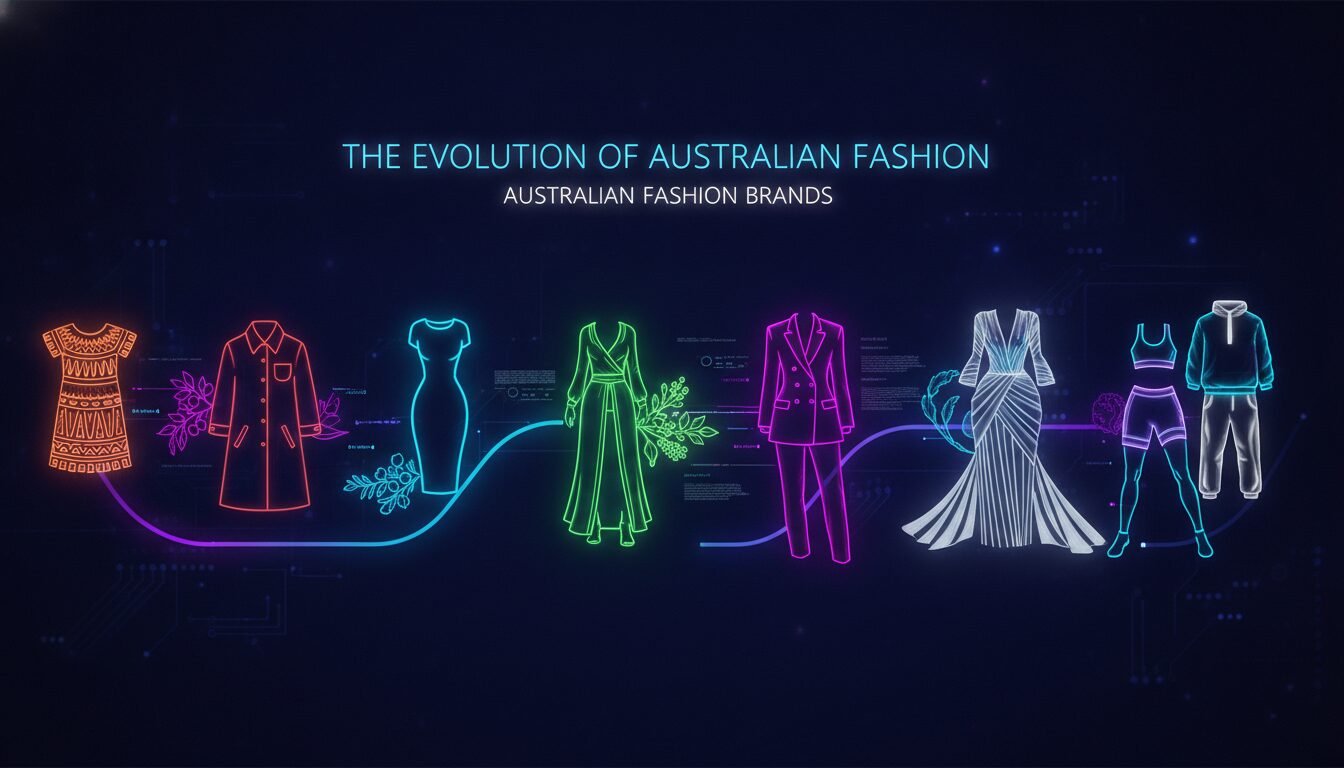
The Evolution of Australian Fashion
Australian fashion evolved from a surf-and-sand uniform into one of the most respected design cultures in the Southern Hemisphere, and the transformation took less than 30 years.
Historical Context
Australia’s fashion scene began to flourish in the late 20th century, shaped by its unique geography and a culture that prizes outdoor living, practicality, and irreverence. Early designers drew on the landscape: the red dust of the outback, the electric blue of the Pacific, the lush greens of Queensland rainforests. These visual references gave Australian fashion a palette and a mood that no European house could replicate. By the early 2000s, designers were gaining international attention, and a genuine industry infrastructure started to form around them.
Current Trends in 2026
Today, the labels that define Australian fashion share three qualities: restraint in silhouette, boldness in fabric choice, and an almost obsessive commitment to wearability. Minimalist aesthetics remain dominant, but 2026 has introduced a harder edge. According to trend forecasting from WGSN, sheer layering, sculptural shoulders, and dark botanical prints are all surging across Australian resort and eveningwear collections this year. Social media, particularly TikTok and Instagram, has accelerated the global reach of these trends, with Australian labels regularly going viral through organic creator content rather than paid campaigns.
Top Australian Fashion Brands to Watch
Here are the most notable labels making waves right now, spanning luxury, mid-range, and emerging categories.
1. Camilla and Marc
Founded by siblings Camilla Freeman-Topper and Marc Freeman, this brand is synonymous with luxury and sophistication. Known for their tailored pieces and chic designs, Camilla and Marc is a first choice for formal occasions, cocktail parties, and any event where showing up underdressed is simply not an option. Their suiting is architectural. Their eveningwear is precise. Price points sit in the premium tier, with dresses typically ranging from AU$400 to AU$900, reflecting the quality of construction and fabric sourcing.
2. Bassike
Established in 2006, Bassike built its reputation on a deceptively simple idea: make the basics so well that they become the most-reached-for pieces in your wardrobe. Their commitment to organic cotton and sustainable production is not a marketing add-on. It is the foundation of every collection. Pieces are designed for longevity, not trend cycles. Mid-range pricing, with core pieces typically between AU$150 and AU$350, makes Bassike accessible without feeling mass-market.
3. Aje
Aje is the brand you reach for when you want to feel both powerful and feminine. Celebrated for bold prints, textural fabrics, and silhouettes that move, Aje focuses on ethical production methods across its supply chain. The brand has expanded internationally, with stockists across the US, UK, and Europe. Their eveningwear translates effortlessly from a Sydney rooftop to a London cocktail party. Expect to invest AU$300 to AU$700 for a signature Aje piece.
4. Zimmermann
No list of Australian fashion brands is complete without Zimmermann. Founded in Sydney in 1991 by sisters Nicky and Simone Zimmermann, the brand has become one of Australia’s most successful luxury exports. Their signature: intricate lacework, romantic ruffles, and prints that feel like wearable art. Zimmermann now operates boutiques in New York, London, Paris, and Los Angeles, with pieces ranging from AU$500 into the thousands. According to WWD, Zimmermann is consistently among the top-performing Australian labels in international wholesale.
5. Ksubi
For the woman who dresses with an edge, Ksubi is the answer. Born in Sydney in 1999, Ksubi built its identity around denim, rebellion, and a refusal to play it safe. Their jeans have cult status globally, worn by everyone from off-duty models to musicians. The brand sits in the mid-to-premium tier, with denim typically priced between AU$250 and AU$450. Ksubi is the label that proves Australian fashion is not just about sun and ease. It has teeth.
Affordable Australian Fashion Brands
Stylish does not have to mean expensive. Several labels deliver trend-forward pieces at prices that do not require a second mortgage.
1. Dissh
Dissh is known for its relaxed, resort-inspired clothing that captures the Australian lifestyle without trying too hard. Their minimalist designs work for casual outings, beach days, and low-key date nights. Most pieces fall between AU$60 and AU$150, making Dissh one of the most accessible labels on this list.
2. Assembly Label
Assembly Label focuses on timeless essentials that are both stylish and functional. Think elevated basics: linen trousers, clean-cut shirts, and dresses that work across multiple occasions. Their commitment to sustainable fabrics keeps the quality high without inflating the price. Core pieces typically range from AU$80 to AU$200.
3. Cotton On
Cotton On is a well-known retail chain offering a wide range of affordable clothing options. Their trend-responsive pieces cater to a younger audience, making them a popular choice among students and young professionals. With items often priced under AU$60, Cotton On is the entry point for anyone building a wardrobe on a budget.
4. Princess Polly
Princess Polly has become a TikTok favourite, and for good reason. The Gold Coast-based brand drops new styles constantly, keeping pace with fast-moving social trends. Their party dresses, co-ords, and going-out tops sit in the AU$50 to AU$120 range. If you want to look like you just stepped off an Australian influencer’s feed, this is where you start.
5. Peppermayo
Peppermayo occupies the sweet spot between affordable and aspirational. Known for feminine silhouettes, floral prints, and occasion-ready dresses, the brand has built a loyal following among women who want to dress up without spending a fortune. Prices typically fall between AU$70 and AU$180.
What to Look For: A Buying Guide for Australian Fashion Brands
Choosing the right label comes down to understanding what you actually need from your wardrobe, not just what looks good on a screen.
Fabric Quality
The best Australian labels are transparent about their materials. Look for organic cotton certifications (GOTS-certified is the gold standard), Tencel or lyocell for drape and breathability, and deadstock or recycled fabrics as a sign of genuine sustainability commitment. Avoid labels that list “polyester blend” without further detail. That is usually a sign that longevity was not a priority.
Sizing and Fit
Australian sizing can differ from US and UK standards. Most labels run true to Australian sizing, which typically runs one size smaller than US sizing. Always check the brand’s specific size guide before ordering internationally. Labels like Bassike and Aje provide detailed measurements, which makes online shopping significantly less stressful.
Sustainability Credentials
Look beyond the marketing language. Genuine sustainability credentials include named certifications (GOTS, OEKO-TEX, B Corp), published supplier lists, and clear information about production locations. According to fashion editors at ELLE Australia, the most credible brands are those that acknowledge they are still improving rather than claiming perfection.
Price vs. Cost-Per-Wear
A AU$400 Camilla and Marc blazer worn 50 times costs AU$8 per wear. A AU$60 fast-fashion equivalent worn 5 times costs AU$12 per wear. The math is not complicated. Invest in pieces from mid-range and premium labels for anything you plan to wear repeatedly. Reserve budget options for trend-driven pieces you know will cycle out of your rotation within a season.
Return and Exchange Policies
International shoppers should check return windows carefully. Most Australian labels offer 14 to 30-day return periods, but some exclude sale items. The Iconic offers free returns within Australia and competitive international return rates, making it a lower-risk entry point for first-time buyers.
How to Style Australian Fashion Brands: Outfit Ideas by Occasion
Knowing the label is only half the equation. Here is how to actually wear these pieces for the nights that matter.
Club Night: Ksubi Denim + Aje Corset Top
Pair Ksubi’s Van Winkle jeans in a dark wash with an Aje structured corset top in a bold print. Add a barely-there heel and a micro bag. The contrast between the raw denim and the feminine top is exactly the kind of duality that makes an outfit memorable. This is the Pretty N Poison approach: soft and dangerous in the same breath.
Rooftop Party: Zimmermann Mini Dress
A Zimmermann lace or printed mini dress needs almost nothing added. Let the dress do the work. Keep accessories minimal: a thin gold chain, small hoops, a strappy sandal. The dress is already the statement. Fighting it with too much jewellery kills the effect.
Date Night: Peppermayo Slip Dress + Assembly Label Blazer
Layer a Peppermayo satin slip dress under an Assembly Label oversized blazer for a look that reads effortless but took thought. The slip dress brings the softness. The blazer brings the structure. Together, they hit the tension between dressed-up and dressed-down that makes date-night dressing interesting.
Cocktail Party: Camilla and Marc Tailored Set
A Camilla and Marc wide-leg trouser and matching blazer in a neutral or deep jewel tone is the cocktail party outfit for women who are done with dresses. It signals confidence, taste, and a refusal to follow the obvious path. Wear it with a pointed-toe heel and a bold lip. Nothing else required.
Festival or Outdoor Event: Dissh Co-ord + Princess Polly Accessories
Dissh’s linen co-ords are built for heat and movement. Pair with Princess Polly’s trend-driven accessories: a crochet bag, layered necklaces, platform sandals. The combination keeps the base relaxed while the accessories do the personality work.
Sustainable Practices in Australian Fashion
Australian fashion brands are among the most sustainability-focused in the world, and the commitment runs deeper than most markets.
Eco-Friendly Materials
Brands like St. Agni and Deiji Studios are known for using sustainable fabrics including organic cotton, Tencel, and recycled materials. St. Agni, in particular, has built its entire identity around slow fashion principles: small-batch production, natural dyes, and supply chains short enough to audit properly. These choices reduce environmental impact and signal a longer-term view of what fashion should be.
Ethical Production
Several labels are committed to ethical labor practices, ensuring fair wages and safe working conditions throughout their supply chains. Brands like Outland Denim go further, actively employing women from vulnerable communities in Cambodia and paying above living-wage rates. This is fashion as a force for something beyond aesthetics, and it is a distinctly Australian approach to the question of what a brand owes the world.
Circular Fashion Initiatives
As of 2026, a growing number of Australian labels have introduced take-back or resale programs. Bassike and several other mid-range brands now partner with resale platforms to extend the life of their garments. According to Who What Wear, circular fashion initiatives are among the fastest-growing segments of the Australian fashion market this year, driven by consumer demand rather than regulatory pressure.
The Impact of Australian Fashion Week
Australian Fashion Week, held annually in Sydney, is now a genuine fixture on the global fashion calendar, drawing international press, buyers, and influencers from across the industry.
Emerging Designers
The event provides a platform for new talent to present collections to an audience that can actually move the needle. Many designers use Australian Fashion Week as their international launch pad, and the results are visible: labels that debuted at the event in recent years now stock in boutiques across Europe and North America. The 2025 edition featured over 60 designers across 5 days of shows, a scale that reflects the industry’s growth.
Global Influence
As Australian Fashion Week gains prominence, it attracts international buyers and media, further enhancing the visibility of local labels on a global scale. Coverage from Vogue, Harper’s Bazaar, and WWD has become standard, not exceptional. That shift in media attention has been one of the most significant drivers of export growth for Australian designers over the past 5 years.
“Australian designers have a confidence now that was not there a decade ago. They are not trying to be European. They are not trying to be American. They are entirely themselves, and that is exactly why the world is paying attention.” – Fashion editor, Vogue Australia
Shopping for Australian Fashion Brands Online
Shopping for these labels online has never been more straightforward, with multiple platforms offering curated access to the full range of Australian design.
Popular Online Retailers
The Iconic is Australia’s largest fashion e-commerce platform, stocking over 1,000 brands including the majority of labels on this list. ASOS features a curated selection of Australian brands for international shoppers, with competitive shipping rates to the US, UK, and Europe. Many brands also operate their own direct-to-consumer stores, which often offer exclusive colourways and early access to new drops.
Shipping and Returns
Most online retailers provide international shipping options, and many offer free returns, ensuring a low-friction shopping experience. Delivery times from Australian brands to the US and UK typically range from 5 to 14 business days, depending on the retailer and shipping tier selected. Express options are available from most major labels for an additional fee, usually between AU$15 and AU$35.
“The growth of Australian fashion e-commerce over the past 5 years has fundamentally changed who can access these labels. Geography is no longer a barrier.” – Industry analyst, Australian Fashion Council
Comparison of Notable Australian Fashion Brands
Brand
Price Range (AUD)
Sustainability Focus
Style
Best For
Camilla and Marc
AU$400–AU$900
Recycled materials
Luxury, tailored
Cocktail parties, formal events
Zimmermann
AU$500–AU$1,500+
Ethical sourcing
Romantic, luxe
Special occasions, rooftop events
Aje
AU$300–AU$700
Ethical production
Feminine, bold prints
Date nights, evening events
Ksubi
AU$250–AU$450
Responsible denim
Edgy, denim-forward
Club nights, casual-cool looks
Bassike
AU$150–AU$350
Organic cotton, GOTS
Minimalist basics
Everyday wear, layering
Assembly Label
AU$80–AU$200
Sustainable fabrics
Timeless essentials
Work-to-weekend dressing
Peppermayo
AU$70–AU$180
Moderate focus
Feminine, occasion-ready
Parties, going-out looks
Princess Polly
AU$50–AU$120
Some sustainable lines
Trend-driven, youthful
Festival, casual nights out
Dissh
AU$60–AU$150
Minimalist approach
Resort, relaxed
Beach days, casual outings
Cotton On
Under AU$60
Some eco lines
Casual, trend-responsive
Budget basics, everyday wear
Pros and Cons of Shopping Australian Fashion Brands
Pros
Strong sustainability credentials across most mid-range and premium labels, with certifications like GOTS and OEKO-TEX backing up the claims.
Distinctive aesthetic that stands apart from European and American design, offering something genuinely different in your wardrobe.
Wide price range from under AU$60 to over AU$1,500, meaning there is a label at every budget tier.
Increasing international accessibility through platforms like The Iconic, ASOS, and brand-direct e-commerce stores.
Strong founder-led creative vision at most labels, resulting in consistent and covetable collections season after season.
Cons
International shipping times can stretch to 14 business days, which is a real consideration for time-sensitive purchases.
Sizing can differ from US and UK standards, requiring careful attention to size guides before ordering.
Premium labels like Zimmermann and Camilla and Marc sit at price points that require genuine investment, which is not accessible for every budget.
Some budget-tier labels prioritise trend speed over sustainability, so not every Australian brand lives up to the industry’s ethical reputation.
Care and Maintenance: Making Your Investment Last
Buying quality Australian fashion brands is only half the equation. How you care for those pieces determines whether they last 2 seasons or 20 years.
Organic Cotton and Natural Fibres
Wash in cold water on a gentle cycle. Avoid tumble drying where possible. Natural fibres like organic cotton and linen respond well to air drying and actually improve in texture over multiple washes. Store folded rather than hung to prevent stretching at the shoulders.
Silk and Satin Pieces
Hand wash or use a delicate machine cycle with a mesh laundry bag. Use a silk-specific detergent and never wring the fabric. Lay flat to dry. Steam rather than iron directly. A well-cared-for silk slip dress from Peppermayo or a satin piece from Aje can last years beyond what the price tag might suggest.
Denim
Ksubi and similar denim-forward labels recommend washing jeans as infrequently as possible to preserve the dye and structure of the fabric. When you do wash, turn inside out, use cold water, and air dry. Spot-clean between washes where practical. Quality denim, properly maintained, improves with age.
Structured Tailoring
Camilla and Marc blazers and tailored sets should be dry-cleaned or professionally steamed rather than machine washed. Store on wide-shouldered hangers to maintain shape. Brush the fabric lightly after each wear to remove surface dust before it settles into the fibres.
General Storage Tips
Keep garments away from direct sunlight to prevent fading. Use cedar blocks rather than mothballs in storage. For delicate pieces, breathable garment bags protect without trapping moisture. Rotate your wardrobe seasonally so pieces are not compressed under the weight of other clothing for extended periods.
Frequently Asked Questions
What clothing brands are popular in Australia?
The most popular Australian fashion brands include Zimmermann, Camilla and Marc, Aje, Ksubi, Bassike, Princess Polly, and Cotton On. These labels span luxury, mid-range, and budget tiers, covering everything from eveningwear to everyday basics. Each has a distinct identity that reflects a different facet of Australian design culture.
What fashion brand is from Australia?
Many globally recognised brands are Australian in origin. Zimmermann was founded in Sydney in 1991. Ksubi launched in Sydney in 1999. Camilla and Marc, Aje, Bassike, Princess Polly, and Peppermayo are all Australian-founded labels with international reach. The Australian fashion industry is significantly larger and more export-oriented than most people outside the country realise.
What are the best Australian luxury clothing brands?
The leading luxury labels from Australia are Zimmermann, Camilla and Marc, and Aje. Zimmermann is the most internationally recognised, with boutiques in New York, London, and Paris. Camilla and Marc is the go-to for precision tailoring and sophisticated eveningwear. Aje sits at the intersection of luxury and wearability, with bold prints and ethical production credentials.
Are there affordable Australian clothing brands?
Yes. Dissh, Assembly Label, Princess Polly, Peppermayo, and Cotton On all offer stylish pieces at accessible prices, with most items falling between AU$50 and AU$180. These labels make Australian design accessible without requiring a premium budget. Princess Polly and Cotton On in particular have strong international shipping programs that make them easy to shop from outside Australia.
What makes Australian fashion brands unique?
Australian fashion brands combine a relaxed, sun-influenced aesthetic with serious craft and a genuine commitment to sustainability. The design culture values wearability and longevity over disposability, which produces pieces that feel considered rather than reactive. According to fashion editors at Vogue Australia, the distinctiveness of Australian design comes from its refusal to simply follow European or American trends.
How can I shop for Australian fashion brands online?
The easiest entry points are The Iconic, ASOS, and individual brand websites. The Iconic stocks over 1,000 brands and ships internationally. ASOS curates a strong selection of Australian labels for US and UK shoppers. Most premium labels like Zimmermann and Camilla and Marc also operate their own e-commerce stores with international shipping and clear size guides for non-Australian customers.
Discover your duality at prettynpoison.com and find the pieces that make your nights unforgettable.
The latest fashion trends 2025 are a collision of dark glamour, earthy texture, and unapologetic edge: sequins at brunch, suede on the dance floor, punk details everywhere. This year rewrote the rules of nightlife dressing for good.
Key Takeaways
Boho suede surged 17% among women (Heuritech, July–September 2025), making it the texture of the year.
Sequins and lingerie dressing redefined nighttime glamour as an all-day, all-night statement.
Sustainable materials including recycled polyester, Econyl®, and deadstock fabrics became non-negotiable for forward-thinking brands.
Color washing in brown and unexpected clashes replaced safe monochrome minimalism.
Preppy heritage pieces got a rebellious nightlife remix for day-to-night dressing.
Hot pants overtook the mini skirt, jumping 14% among Gen Z consumers by late 2025.
The Defining Aesthetics of the Latest Fashion Trends 2025
Boho Chic in Suede
Suede is the texture that defined 2025, anchoring a bohemian revival that had been building since the early 2020s. Designers like Chloé, Dries Van Noten, and Marni showcased long skirts, oversized shirts, and matching sets in rich tan, chocolate, and caramel hues. Suede signals relaxed luxury, and its tactile warmth hit different after seasons of hyper-technical fabrics. According to trend forecasting platform Heuritech, suede fabric saw a 17% year-over-year increase in adoption among women between July and September 2025, while suede loafers specifically jumped by 30% in the same window. Men’s runways also caught the wave, with a 13% rise in matching suede sets during spring/summer 2025 shows. This wasn’t just a fabric moment. It was a cultural reset toward earthy, artisanal roots that consumers were actively craving.
Modern Prep & Heritage Fabrics
Preppy fashion got a full personality transplant in 2025. Heritage fabrics like tweed, argyle knit, and corduroy were reinterpreted by Ralph Lauren, Burberry, and Louis Vuitton, moving far beyond collegiate clichés. Vogue’s coverage of fall/winter 2025 trends highlighted “Modern Prep” as a defining movement, featuring layered button-downs, sharp pencil skirts, and relaxed varsity jackets. Glamour also flagged the “Town and Country Chic” direction, where earthy plaids and luxuriously thick outerwear dominated the conversation. The real appeal: mixing old-school elegance with streetwise layering. Thrift a vintage plaid blazer or invest in a sustainable tweed. Either way, you win.
Aquatic Wonderland
The aquatic trend in 2025 went far beyond nautical stripes. Fendi and Stella McCartney sent iridescent fabrics, shell-like embellishments, and fluid silhouettes down the runway, evoking coral reefs and deep-sea fantasy. Heuritech’s trend forecast noted that the palette of aquatic blues, seafoam greens, and pearlized whites signaled a collective hunger for escapism. This trend also bridged fantasy and responsibility: recycled ocean-plastic fabrics became a natural fit for the aesthetic. For the nightlife crowd, an aqua sequin dress or a shell-encrusted clutch became the ultimate statement piece of the season.
Powder Pink and Flapper Fringe
Two trends competitors flagged that deserve serious attention: powder pink and flapper fringe. Powder pink moved away from the bubblegum saturation of previous years into something softer and more dangerous, a blush that reads innocent until it doesn’t. Pair it with dark accessories and the Pretty N Poison duality writes itself. Flapper fringe, meanwhile, brought movement back to nightlife dressing in a major way. Fringe-hem dresses and fringe-trimmed jackets created kinetic energy on the dance floor that no static silhouette can match. Both trends align perfectly with our Pretty Edit and Poison Edit aesthetics.
How the Latest Fashion Trends 2025 Elevated Nightlife Style
24/7 Sequins for Nightlife
Sequins are no longer reserved for New Year’s Eve desperation. Prada and Gucci showcased sequin tops, dresses, and pants designed for round-the-clock wear, and the trends 2025 made this the new normal. The move was to temper the shine with matte: a chunky knit over a sequin skirt, or combat boots under a sequin gown. Stylists across the board agreed that disco-dressing is a form of self-expression, not a costume. For the sustainability-conscious, vintage and deadstock sequin pieces offered guilt-free sparkle, since recycling existing garments cuts the environmental cost of virgin plastic production significantly.
Lingerie Dressing Goes Out
Sheer fabrics, lace, and satin slips left the boudoir and hit the streets in 2025. The “Lingerie Dressing” trend, reported by Vogue, saw Dolce & Gabbana and Versace blur the line between intimate apparel and evening wear. For nightlife, this translated to bralettes under blazers, lace-trimmed camis peeking from leather jackets, and slip dresses layered over turtlenecks. The look is inherently sensual and built for the dance floor. Many indie designers embraced deadstock lace and zero-waste patterning to create these delicate pieces, making ethical partywear a real and beautiful option.
Uptown Punk: Edgy Details That Hit
Punk attitude got a polished upgrade in 2025. Safety-pin embellishments on tailored jackets, patent leather trench coats, tartan kilts with chunky platform boots. As Vogue noted, this look balanced rebellion with refinement, making it ideal for warehouse parties and upscale clubs in equal measure. Key pieces included a Burberry check kilt with a beat-up band tee, or Alexander McQueen’s studded leather belts cinching a minimalist dress. The DIY ethos was central: customization and upcycling weren’t just accepted, they were the point. Old garments got a rebellious new life, and the look was better for it.
Strapless and Asymmetrical: The Silhouettes That Ruled
The strapless dress had a full comeback moment in 2025, appearing across runways in structured bodice forms that felt powerful rather than precarious. Asymmetrical silhouettes ran alongside it, with one-shoulder cuts and uneven hemlines creating visual tension that reads as intentional and bold. These shapes are built for nightlife. They demand attention without asking for it. Both silhouettes sit at the core of our Night Ritual collection, designed specifically for women who dress to be remembered.
Sustainable Materials Shaping the Latest Fashion Trends 2025
Recycled Polyester and Econyl®
Sustainable materials became non-negotiable across the this type of 2025, not just a nice-to-have footnote. Econyl®, a regenerated nylon made from recovered ocean waste, appeared in everything from swimwear to party dresses. Stella McCartney continued her leadership in ethical fashion, using forest-friendly viscose and recycled polyester across her collections. The shift was commercial as much as ethical: consumers actively sought brands that disclosed their sustainability practices transparently. Rental platforms like Hurr and By Rotation reported spikes in demand for high-end sustainable partywear, confirming that the market had genuinely shifted.
Deadstock and Upcycled Fabrics
Deadstock, the leftover fabrics from fashion houses, became a prized resource in 2025. Designers like Marine Serre and smaller indie labels built entire collections from repurposed materials, turning excess into exclusivity. For the nightlife crowd, one-of-a-kind pieces made from deadstock sequins or reclaimed leather offered a way to stand out without contributing to landfill. Upcycling extended to DIY culture too: tutorials on transforming outdated dresses into corset tops or patchworking skirts pulled millions of views on social media, signaling a genuine cultural shift toward conscious creativity.
Leather Alternatives: Mushroom & Pineapple
Innovations like Mylo™ (mushroom leather) and Piñatex® (pineapple leaf fiber) entered the mainstream conversation in 2025, offering cruelty-free alternatives for jackets, bags, and party boots. These materials are still evolving, but they provided a vegan answer to the ubiquitous leather trends dominating the runways. Brands like Matt & Nat and Stella McCartney championed these bio-based materials, proving that sustainability and style can coexist without compromise or sacrifice.
Color Trends That Defined the Latest Fashion Trends 2025
Yellow’s Golden Glow
Yellow owned 2025, from creamy vanilla to deep saffron. Alaïa’s sunflower dresses and Bottega Veneta’s buttery leather goods cemented the shade’s must-have status across the year. Heuritech quantified the surge: vanilla yellow rose by 11% and saffron yellow by 6% from April to June 2025 compared to the prior year. For nightlife, a saffron slip dress or vanilla leather trousers delivered an energetic alternative to the default black. The shade worked as a full monochrome statement or as a pop against deep neutrals. Either way, it turned heads.
Curious Color Combinations
Safe neutrals were officially cancelled in 2025. The color palette thrived on unexpected clashes: pale pistachio with a flash of red, icy blue paired with chocolate brown. Vogue described this as “Curious Color Combinations,” a rule-breaking approach that mirrored the increasingly fragmented digital aesthetic landscape. Brands like Tory Burch and Stella McCartney embraced these dissonant pairings, proving that intuition beats convention every time. For party looks, this meant bubblegum pink with lime green, or violet with orange. The louder, the better. No apologies.
Monochrome Brown
Brown dethroned black as the reigning neutral of 2025. From camel coats to espresso leather, the shade conveyed understated wealth and warmth without trying too hard. The “color washing” technique, wearing multiple shades of the same hue in a single look, made brown the ideal base for tonal layering. For nightlife, a chocolate satin slip or a cognac leather miniskirt became quietly seductive choices that hit different than the predictable all-black uniform.
Powder Pink: The Soft Threat
Powder pink emerged as one of the most subversive shades in the this kind of trends 2025. It reads soft. It reads romantic. Then you add the leather accessories and the dark lip, and suddenly it reads dangerous. That contrast is exactly the Pretty N Poison duality in color form. According to trend reporting from Who What Wear, powder pink appeared across both ready-to-wear and accessories in a way that felt fresh rather than saccharine, particularly when styled against harder textures and darker tones.
Key Pieces from 2025 to Own Right Now
Hot Pants: The New Mini Skirt
Hot pants made a decisive comeback in 2025, overtaking the mini skirt as the leg-baring staple of the season. On the Fendi and Marni runways, they appeared in denim, leather, and sequin variants, styled with sheer stockings or knee-high boots. Heuritech’s data confirmed a 7% rise in hot pants adoption from April to June 2025, followed by a 14% surge from July to September among Gen Z consumers. This style is unapologetically youthful and built for festival circuits and club nights. To wear it sustainably, hit the thrift stores or upcycle your own cutoffs.
The Funnel-Neck Jacket
The funnel-neck jacket was 2025’s minimalist answer to cold-weather dressing. J.Crew’s accessible versions and high-end iterations from The Row and Phoebe Philo made it an essential across price points. The collar delivers subtle drama that transitions from office to evening without effort: add a statement necklace or swap trousers for leather pants and the whole energy shifts. Its timelessness means it earns its place in a slow-fashion wardrobe for multiple seasons, not just one.
Barn Jackets & Country Codes
Barn jackets, Mac coats, and rubber boots moved from rural utility to urban cool in 2025. Burberry, Gucci, and Altuzarra reimagined these hardy classics in luxurious wool and tweed, while original functional versions from Barbour and L.L.Bean saw renewed demand. Vogue called the aesthetic “country-coded,” but its durability made it a genuinely sustainable investment. These pieces are built to last decades, not seasons, which is exactly the kind of fashion math that makes sense in 2026.
The Little White Tank and Parachute Pants
Two pieces that competitors flagged as breakout items deserve their moment here. The little white tank became the ultimate blank canvas of 2025, styled under blazers, tucked into leather skirts, or worn alone with maximum confidence. Parachute pants, with their relaxed utilitarian silhouette, offered a high-fashion take on comfort dressing that translated surprisingly well to nightlife when paired with a sharp crop or a structured corset. Both pieces reflect the the fashion trends 2025 obsession with contrast: effortless on top, intentional underneath.
Pros and Cons of the Latest Fashion Trends 2025
Pros
Versatility across occasions: Trends like sequins, suede, and lingerie dressing work for clubs, rooftop parties, date nights, and cocktail events without requiring a full wardrobe overhaul.
Sustainability built in: Deadstock fabrics, Econyl®, Mylo™, and rental platforms mean you can chase the latest fashion trends 2025 without the environmental guilt.
Range of price points: From Chloé suede sets to thrifted vintage finds, these trends are accessible whether your budget is $50 or $5,000.
Strong nightlife identity: Uptown punk, lingerie dressing, and 24/7 sequins give nightlife dressers a clear, confident aesthetic to own.
Color freedom: Curious color combinations and color washing mean there are no wrong answers, just bolder ones.
Cons
Trend saturation: With so many directions running simultaneously, building a cohesive wardrobe around the latest fashion trends 2025 requires real editorial instinct.
Sustainable options still limited: While Econyl® and Piñatex® are growing, truly sustainable partywear at scale remains harder to find than conventional alternatives.
Some trends are highly seasonal: Aquatic influences and powder pink may feel dated faster than investment pieces like suede or funnel-neck jackets.
DIY punk requires commitment: The uptown punk aesthetic rewards customization, but half-executed safety-pin styling reads as costume rather than fashion.
Runway vs. Street: How 2025 Trends Translated
The latest fashion trends 2025 lived two lives simultaneously: one on the runway, one on the street. Here’s how the gap between aspiration and accessibility actually played out.
DIY kilt skirts with band tees; chain belts on thrifted trousers
Alexander McQueen, Burberry, Vivienne Westwood
Country-Coded
Wool kilts, barn jackets in check patterns, silk scarves
Oversized plaid shirts; Barbour jackets; corduroy pants from Uniqlo
Gucci, Burberry, Ralph Lauren
How to Style 2025 Trends for 2026 and Beyond
Step 1: Start with a Heritage Piece
Anchor your look with a tweed blazer, cable-knit vest, or barn jacket. These pieces carry weight and history. They signal that you know what you’re doing before you’ve said a word.
Step 2: Layer a Provocative Camisole Underneath
A lace or satin camisole beneath a structured outer layer creates the lingerie-dressing tension that defined the latest fashion trends 2025. The contrast between hard and soft is the whole point.
Step 3: Swap Trousers for a Mini Kilt or Leather Shorts
The bottom half is where the nightlife energy lives. A mini kilt or high-waisted leather shorts instantly shifts the look from day to after-dark without touching the top half.
Step 4: Add Unexpected Accessories
Chain belt, platform boots, or a sequin bag. Pick one element that disrupts the rest of the look. The best 2025 outfits had at least one thing that didn’t quite belong, and that was exactly why they worked.
Step 5: Finish with Bold Makeup
A sharp winged liner or a dark lip pulls the entire look into focus. Makeup isn’t an afterthought in 2025 nightlife dressing. It’s the punctuation mark at the end of a very confident sentence.
Mixing Eras: 1990s Plaid + 2025 Sequins
The ’90s plaid trend, identified by Who What Wear as one of the standout directions of the year, integrates with party elements in a way that feels genuinely fresh. Pair a vintage flannel shirt tied at the waist over a sequin midi skirt, add chunky loafers, and you have a look that bridges grunge and glamour. It’s ideal for a concert or a late-night bar. The key is balancing the laid-back with the luminous so neither overwhelms the other.
Sustainable Party Capsule: Your Checklist
To future-proof your wardrobe while honoring the latest fashion trends 2025, build a sustainable party capsule around these five pieces:
One statement jacket (vintage or recycled leather).
Two tops (a deadstock sequin crop and a lace camisole).
One versatile bottom (high-waisted hot pants in upcycled denim).
One dress (a slip made from responsible viscose or Econyl®).
Accessories (a pre-loved clutch and ethical metallic heels).
“The most exciting thing happening in fashion right now is the collapse of the day-to-night divide. Sequins at brunch, suede at midnight. The rules are gone.” – Fashion editor perspective, aligned with Vogue’s fall/winter 2025 trend reporting.
“Sustainable partywear is no longer a contradiction. Deadstock sequins, Econyl® dresses, rental platforms: the infrastructure now exists for nightlife dressing that doesn’t cost the planet.” – Industry observation, per rental platform data from Hurr and By Rotation, 2025.
Frequently Asked Questions
What were the biggest fashion trends in 2025?
The biggest trends in the latest fashion trends 2025 included boho suede, hot pants, aquatic influences, prep revival, powder pink, and party-centric styles like 24/7 sequins and uptown punk. Sustainable materials ran as a through-line across all of them, making eco-conscious dressing a mainstream expectation rather than a niche choice.
What is out of style for 2026?
Safe monochrome minimalism, all-black default nightlife dressing, and overly polished “clean girl” aesthetics are losing ground fast. As of 2026, the energy has shifted toward bold color combinations, textural contrast, and looks that carry a clear point of view. Blending in is the only real fashion mistake.
What is the biggest fashion trend right now?
The biggest single trend carrying momentum from 2025 into 2026 is the duality aesthetic: soft and dangerous, pretty and poisonous, heritage and rebellious in the same look. Sequins with combat boots, lace under leather, suede with punk hardware. The contrast is the trend.
What will be in fashion in autumn 2025?
Autumn 2025 was defined by monochrome brown, country-coded outerwear, uptown punk details, and the funnel-neck jacket as a transitional essential. Vogue’s fall/winter 2025 coverage confirmed Modern Prep and heritage fabrics as the dominant direction, while nightlife dressing leaned into lingerie-inspired layers and 24/7 sequins.
How can I wear 2025 trends sustainably?
Opt for vintage, secondhand, or rental pieces from platforms like Hurr and By Rotation. Prioritize brands using recycled fabrics like Econyl®, deadstock materials, or innovative plant-based leathers like Mylo™ and Piñatex®. Upcycling and DIY customization let you adapt the latest fashion trends 2025 without consuming new resources or contributing to textile waste.
Did sustainable fashion become mainstream in 2025?
Yes. Sustainable fashion moved firmly into the mainstream across the latest fashion trends 2025, with major houses and high-street brands adopting recycled materials, rental models, and transparent supply chains. Consumer demand for ethical options drove this shift commercially, not just culturally, making sustainability a business imperative rather than a brand differentiator.
Satin dresses for women are garments made from a glossy, smooth weave that catches light and skims the body, built for nightlife, formal events, and anyone who refuses to blend in. We’re breaking down every fabric, cut, and price point that matters.
Key Takeaways
for women deliver a glossy, dangerous shine that works for nightlife, formal events, and alternative styling alike.
Fabric composition matters most: silk drapes cooler and breathes better, while polyester satin resists wrinkles and survives heavy hardware like chains and harnesses.
Popular silhouettes include the slip, wrap, maxi, and edgy corset mini, spanning roughly $25 to $177+ depending on brand and construction.
Style satin dresses for women with leather jackets, harnesses, or platform boots for an alt edge, or keep it minimal with strappy heels for elegance.
Care demands gentle handling: hand wash or delicate-cycle for polyester, dry clean for silk, and always air dry to protect the sheen.
What to Look for When Buying Satin Dresses for Women
Fabric Composition: Silk vs. Polyester Satin
The best satin dresses for women come down to one choice: silk or polyester. Satin itself is a weave, not a fiber. It’s characterized by a high-gloss front and a matte back, and that construction is what creates the liquid shine we live for. Silk satin, spun from natural protein fibers, offers unmatched breathability and a buttery drape, but it demands delicate care and a bigger budget. Polyester satin, often marketed as charmeuse, replicates silk’s luster at a fraction of the cost, resists wrinkles, and survives a machine wash. According to Adrianna Papell, satin’s glossy finish reflects light beautifully, which is exactly why it photographs like a dream under club lighting or camera flash. If you’re the type who layers chains, harnesses, or O-rings over your look, polyester satin holds up better under that kind of hardware night after night.
Fit and Drape: Why Bias Cut Matters
A bias cut is what separates a cheap costume from a dress that moves like it belongs on you. It means the fabric is sliced at a 45-degree angle to the weave, granting natural stretch so the dress skims your curves instead of clinging or bunching. This technique defines nearly every satin slip dress worth owning, creating that liquid, poured-on silhouette. A cowl neck, that soft draped fold at the neckline, adds even more movement and flatters smaller busts especially well. When you’re trying on satin dresses for women, check that seams lie flat and nothing pulls across the hips. That’s your fit test.
Lining and Construction Quality
Cheap satin dresses often skip lining entirely, which leads to static cling and unwanted transparency the second you walk under a spotlight. Look for a full polyester or silk habotai lining every time. Check the inside seams too: French or flat-felled seams signal a dress built to survive more than one wear. If the piece includes cutouts or lace inserts, a signature move at brands like NastyGal, make sure those trims are secured tight so they won’t fray after a few nights out.
Popular Satin Dress Silhouettes
The Slip Dress
A slip dress is a minimalist, lingerie-inspired piece cut on the bias with spaghetti straps, and it remains the ultimate canvas for layering. Pair it with a fishnet top underneath and chunky boots for a punk rave look, or throw a tailored blazer over it for the after-party. Lulus’ Favorite Icon cowl neck slip, priced at $69, is a bestseller with five color options. This is exactly the energy behind our Night Ritual edit: pieces that do double duty from pregame to last call.
Wrap Dresses
Wrap silhouettes feature a front closure that ties at the waist, suiting hourglass and pear shapes especially well. Satin wrap dresses for women often arrive with dramatic sleeves or high-low hems that add drama without extra effort. They transition effortlessly from a boardroom (camisole underneath, obviously) to evening cocktails with zero outfit change required.
Maxi Dresses
Floor-sweeping satin maxi dresses deliver undeniable drama, full stop. Lulus’ Still the One emerald green floral print maxi is one of the brand’s bestsellers at $89, proof that bold color sells. For an alternative take, choose a black maxi with cutout lace panels. NastyGal alone carries over 1,000 satin dress styles, many featuring intricate cutwork detail built for exactly this kind of drama.
Mini Dresses with Edge
Satin mini dresses are nightlife staples, no debate. Structured, boned corset minis add a fetish twist straight from our Poison Edit playbook, while puff sleeves and playful prints lean retro and romantic, more Pretty Edit in spirit. NastyGal’s satin floral ruffle mini starts around $36, making it one of the most accessible designer-look options on the market.
Alternative Styles: Corset and Cutout Details
Beyond the classics, satin dresses embracing goth and club-kid aesthetics keep climbing in popularity. Look for corset lacing, underbust cutouts, O-ring hardware, and asymmetrical hems. These designs mix satin’s softness with an aggressive silhouette, the exact duality we build our entire brand around. Pair one with platform creepers and a spiked choker for a look that owns the dance floor before you even step onto it.
Satin Dresses for Different Body Types
The right satin dress silhouette depends on which curves you want to highlight and which you’d rather skim past. Bias-cut slips and wrap styles flatter nearly every shape because they move with the body instead of fighting it. Pear shapes tend to love wrap and A-line satin styles that define the waist while easing over the hips. Hourglass figures can go bolder with body-hugging slips, since the bias cut already does the shaping work. Petite frames often look longest and leanest in a satin mini or a high-slit maxi, while fuller busts benefit from cowl necks or structured corset bodices that offer real support instead of relying on thin straps alone. According to Who What Wear’s style guidance, the biggest fit mistake shoppers make with satin is sizing down. Because the fabric has minimal stretch outside a bias cut, sizing up and tailoring down almost always looks better than fighting a too-tight seam.
Top Satin Dresses for Women: Style Breakdown
Style
Best For
Price Range
Where to Shop
Slip Dress
Layering, clubwear, casual edge
$25-$99
Lulus, NastyGal, ASOS
Wrap Dress
Office-to-evening, curves
$50-$128
Lulus, Adrianna Papell
Maxi Dress
Weddings, formal, alt-glam
$69-$177
Lulus, NastyGal, Adrianna Papell
Mini Dress
Parties, festivals, edgy day looks
$36-$120
NastyGal, ASOS
Corset/Cutout
Alternative, club, rave
$48-$177
NastyGal and similar alt-fashion retailers
“Satin’s reflective quality makes it a standout for nighttime. Just add a leather jacket and combat boots for an edgy contrast,” says fashion stylist Morgan Tremaine.
According to Vogue’s runway coverage of recent seasons, satin has moved firmly beyond bridal and red-carpet territory into everyday going-out wear, with designers pairing the fabric against harder textures like leather and metal hardware to keep it from feeling too precious.
How to Style Satin Dresses for Every Occasion
Nightlife and Club Styling
The best way to style satin for a club night is to juxtapose the fabric’s slinkiness with tough textures. Think a cropped moto jacket, fishnets, and strappy stilettos. Metallic accessories amp up the shine even more. A satin slip dress becomes a whole outfit the second you layer a mesh longsleeve underneath and cinch the waist with a wide belt.
Alternative and Goth Satin Looks
Global street style coverage out of Tokyo’s Harajuku district and Berlin’s techno scene confirms satin isn’t reserved for bridesmaids anymore. Pair a black satin maxi with a harness, a studded choker, and knee-high platform boots. Opt for styles with corset boning or lace-up backs. NastyGal’s boned corset mini, frequently discounted up to 70% off, delivers a high-impact look for under $60. DIY enthusiasts even add safety pin embellishments or bleach splatter to warehouse satin finds for a one-of-one piece.
Wedding Guest, Prom, and Formal Events
Satin’s inherent elegance makes it a natural choice for weddings, prom, and homecoming alike. Jewel tones like emerald, sapphire, and burgundy are perennial favorites for exactly this reason. Adrianna Papell’s satin gowns highlight the fabric’s dreamlike drape, and the brand recommends sticking to strappy sandals and minimal jewelry so the dress does the talking. For prom specifically, a satin mini or a fitted midi with a slit reads modern without trying too hard, while a corset-bodice satin gown brings main-character energy to homecoming.
Where to Shop for Satin Dresses for Women
Budget-Friendly ($25-$50)
ASOS DESIGN and NastyGal offer the deepest selection under $50. NastyGal’s catalog of over 1,000 satin dresses frequently goes on sale with discounts up to 70% off, bringing prices as low as $36 for a mini dress. Lulus also stocks options starting around $25, including basic slip dresses in a handful of colors.
Mid-Range ($50-$120)
This tier is the sweet spot for quality and design. Lulus’ bestselling Beyond Classy halter midi ($75) comes in 11 colors and earns strong reviews for its wrinkle-resistant satin. NastyGal’s structured minis with cutouts, along with other premium satin pieces, tend to sit around $70 to $100.
Premium ($120+)
For heirloom-quality satin, invest in silk. Lulus’ Mercedes white satin cape wedding dress runs $128, while Adrianna Papell’s evening gowns start above $200. Higher prices typically buy full silk lining, French seams, and safety certifications like OEKO-TEX Standard 100 for chemical safety.
Pros and Cons of Satin Dresses for Women
Pros
Glossy, light-reflective finish that photographs beautifully under club lighting or camera flash
Versatile across silhouettes: slip, wrap, maxi, and mini all work in satin
Polyester satin resists wrinkles and survives machine washing on delicate
Wide price range means there’s an entry point from roughly $25 up to $177+
Works across occasions, from rave to red carpet to wedding guest
Cons
Silk satin requires dry cleaning or careful hand washing, which adds cost and effort
Minimal stretch outside bias-cut styles means fit issues if you size down
Snags easily on rough jewelry, Velcro, and wire hangers
Cheap, unlined satin can cling and turn see-through under strong light
Static cling is common with lower-quality polyester versions
Caring for Your Satin Dresses
Washing and Stain Removal
Polyester satin dresses for women can usually go in the machine on a delicate cycle in cold water, but always turn the dress inside out first and place it in a mesh bag. Silk satin demands dry cleaning or gentle hand washing with pH-neutral soap instead. Never wring satin, since twisting can permanently crease the weave. For oil-based stains like makeup or food, sprinkle cornstarch on the spot to absorb the grease before washing it out.
Storing to Prevent Snags
Satin’s smooth surface snags easily, so treat it accordingly. Hang satin dresses on padded or velvet hangers, since wire hangers catch and pull threads fast. If you must fold instead, place acid-free tissue paper between the layers to protect the sheen. Keep garments away from Velcro, zippers, and rough jewelry whenever they’re stored in a closet.
Frequently Asked Questions
How do I know if a satin dress fits properly?
A well-fitting satin dress should glide over your body without pulling at the seams or creating horizontal stress lines. The fabric shouldn’t gap at the bust or ride up when you walk. Because satin has minimal stretch unless it’s cut on the bias, check the size chart and size up if you’re between sizes, since alterations are far easier than trying to let out a tight dress.
Can I wear a satin dress if I’m plus-size?
Absolutely, and the options keep expanding. Many retailers, including NastyGal and ASOS, offer extended size runs, and Lulus carries sizes up to 3X. Look for bias-cut styles that skim curves rather than cling, plus structural details like waist ties, wrap closures, or structured shoulder-pad styles designed to balance proportions.
What’s the difference between satin and silk?
Satin is a weave type that creates a glossy face and a dull back, while silk is a natural fiber. Silk satin uses actual silk threads, but most affordable satin dresses for women use polyester filaments instead. Polyester satin replicates silk’s sheen and holds up better to machine washing, while silk breathes better and feels cooler against skin.
Are satin dresses machine washable?
It depends on the fiber. Polyester satin is generally safe for a delicate machine wash in cold water with mild detergent. Silk satin should be dry-cleaned or hand-washed with care instead. Always check the care label first, since some manufacturers include specific instructions to preserve the sheen.
How can I de-wrinkle a satin dress without damaging it?
Use a handheld steamer on the lowest setting, holding it several inches from the fabric at all times. If you must iron, turn the dress inside out, place a pressing cloth between the iron and the satin, and use the lowest heat setting available. Avoid direct contact with the iron, since it can melt polyester fibers or leave permanent shine marks behind.
What is the best value satin dress brand?
For budget-conscious shoppers, NastyGal offers the widest range with frequent 60 to 70 percent off sales that bring many dresses under $50. Lulus provides consistent quality across a catalog of 417 styles without the extreme sale swings. ASOS DESIGN is another strong option, especially for trendy, occasion-specific pieces.
Own the Night in Satin
Satin dresses for women offer that rare combination of luxury and rebellion in one weave. Whether you’re sliding into a bias-cut slip for a rave, rocking a corseted mini for a night that gets messy in the best way, or sweeping into a wedding in a liquid maxi, satin adapts to your world instead of asking you to adapt to it. Prioritize fabric quality, fit, and styling, and you’ll invest in pieces that hold up season after season. As of 2026, a shift toward sustainable satins, including recycled polyester and deadstock silk, is expanding the options even further. Discover your duality at prettynpoison.com and shop pieces built for exactly the kind of night you’re planning.
Key Takeaways
Summer 2025 fashion trends celebrated maximalism, personal style, and a mix of nostalgic micro-trends built for self-expression.
Key items included flip-flops, jelly sandals, lace trims, tassels, and mesh market totes, according to Vogue.
Sustainable and alternative fashion gained serious traction, with DIY, upcycling, and gender-fluid approaches leading the charge.
Color palettes swung from bold reds and vivid brights to soft, romantic hues – sometimes in the same outfit.
Matching sets, sculptural skirts, and sneakerinas offered wearable yet statement-making options for every occasion.
As of 2026, the season’s core values of texture play, inclusivity, and creative styling continue to shape what we wear after dark.
Summer 2025 fashion trends are a maximalist, dopamine-fueled collision of nostalgia and nightlife-ready edge. From jelly sandals to lace-adorned silhouettes, the season merged comfort with bold self-expression.
The Defining Spirit of Summer 2025 Fashion Trends
fashion trends marked a full pivot away from quiet luxury and into something far more interesting: joyful, expressive, and unapologetically personal.
A Shift Toward Individuality
According to Who What Wear, the spring/summer 2025 runways signaled a departure from years of minimalism. Designers championed a renewed sense of softness and a new maximalism that prioritized personal style over uniformity. This was not about loud logos. It was about expressive silhouettes, unexpected texture play, and a joy-filled approach to getting dressed. The season became a canvas for self-expression, encouraging wearers to break free from sartorial constraints entirely.
Softness Meets Maximalism
The interplay between fluidity and opulence defined everything. Who What Wear noted that even brands known for edgy aesthetics, like Khaite, embraced softer palettes and romantic silhouettes. Bottega Veneta infused its collection with childlike whimsy. Saint Laurent paired soft power dressing with decadent accessories. Power could be gentle. Maximalism could be understated. The season proved both.
Runway Highlights
Across the four fashion capitals – New York, London, Milan, and Paris – designers contributed to the this type of trends lexicon in ways that felt genuinely fresh. Prada and Valentino emphasized highly personal looks through inventive styling. Chanel returned to the Grand Palais with airy, light-filled designs. This global stage set the tone for a season where micro-trends flourished alongside overarching themes of opulent romance.
“Flip-flops achieve both a carefree spirit and an impossibly chic one. The style is quintessentially summer.” – Madeline Fass, Senior Shopping Market Editor, Vogue
Top Micro-Trends from Summer 2025 Fashion Trends
The season’s micro-trends were specific, fast-moving, and deeply covetable – exactly the kind of details that separate a good outfit from an unforgettable one.
Flip-Flops and Jelly Sandals
Vogue editors highlighted 11 summer trends, and flip-flops sat near the top of the list. Leather versions by Toteme ($480) and Aeyde ($325) elevated the humble thong sandal. Gap’s $15 Eva flip-flops made the trend accessible to everyone. Jelly sandals, once a childhood staple, reappeared on runways like Chloé, offering a translucent, playful alternative with serious Y2K energy. Pinterest reported 6,000 searches for summer 2025 trends, with nostalgic footwear picks driving significant traffic.
Lace Trims and Sheer Fabrics
Lace brought a sultry, bohemian romance to the season. Designers like Dôen and Faithfull leaned into delicate lace trims on dresses and skirts. Leset and Loulou de Saison offered modern, fluid silhouettes that felt fresh rather than fussy. Styling these pieces with contrasting elements – baby tees, flat sandals, chunky jewelry – kept the look from veering too precious. The rise of crochet, lace, and mesh textures, highlighted by both Jolynne Shane and Merrick’s Art, reinforced the season’s obsession with open-knit, breathable fabrics that move with you on the dance floor.
Tassels and Shell Accents
Tassels emerged as a minimalist-bohemian hybrid. Think monochromatic pendant necklaces from Juju Vera (around $595) and decorative pochettes that added movement to every step. Shell jewelry became a mainstay, instantly turning basics into vacation-ready statements. These tactile embellishments carried an artisanal, handcrafted feel that resonated deeply with the maximalist mood of the season.
Color Palette and Prints
Color was not optional this summer. It was the whole point.
Bold Reds and Vivid Hues
Red reigned supreme, from cherry to crimson, alongside cobalt blue, tangerine, and hot pink. Jolynne Shane noted these saturated shades as easy entry points into this kind of fashion trends, especially for wardrobes built on neutrals. Monochromatic dressing in a single bold color offered a fashion-forward, cohesive look that was both striking and simple to execute. One color, head to toe. Maximum impact, minimum effort.
Polka Dots and Stripes
Classic patterns saw a full resurgence. Vogue editors Chloe Malle and Leah Faye Cooper singled out polka dots and stripes as joyful, print-happy staples of the season. Matteau’s gathered polka-dot midi dress (around $690) exemplified how the season reinvented timeless motifs with modern volume and fluidity. Old-school patterns, new-school attitude.
Neutral Foundations
Amid the riot of color, soft neutrals provided balance. Shades like powder blue, misted marigold, and white grape – spotted across Pinterest trend boards – served as calming counterpoints, allowing bolder accessories or statement layers to do the talking. This duality kept the season versatile and genuinely wearable across occasions.
Key Silhouettes and Items
The shapes that defined summer 2025 were built for movement, confidence, and staying out past midnight.
Matching Sets and Coordinated Looks
Matching sets continued their reign, praised by Jolynne Shane for their effortless, travel-friendly appeal. Linen tops with coordinating shorts or knit tanks with midi skirts allowed mix-and-match flexibility while delivering a polished, intentional aesthetic. For nightlife, a matching set in a bold print or rich jewel tone is the easiest way to look like you planned everything – even if you threw it on in ten minutes.
The Rise of Sculptural Skirts
Skirts took center stage. Sporty midis and voluminous silhouettes challenged the dominance of pants across every price point, from accessible high-street options to high-end sculptural versions. The skirt became a statement piece, often styled with sneakerinas for a sporty-meets-feminine twist that felt genuinely new. Our Poison Edit captures exactly this energy: structured, bold, built to be noticed.
Sneakerinas and Sporty Flats
The sneakerina – a hybrid of sneaker and ballet flat – epitomized the season’s love for unexpected footwear. Adidas Originals’ Taekwondo Mei (around $120) and Nike Air Force 1 Shadows (around $135) blended comfort with a fashion-forward edge. Contrast and playful fusion were the whole point. Wear them with a lace midi and watch the room react.
Pros and Cons of Summer 2025 Fashion Trends
Every season has its highs and its complications. Here is the honest breakdown.
Pros
Maximalist freedom: The season actively encouraged personal expression over rigid trend-following, making it easier to dress for yourself.
Wide price range: Flip-flops alone spanned from $15 (Gap) to $480 (Toteme), meaning the trends were genuinely accessible at multiple budgets.
Nightlife-ready silhouettes: Lace, mesh, sheer fabrics, and sculptural skirts translated directly to after-dark dressing without any styling gymnastics.
Sustainability built in: DIY, upcycling, and vintage sourcing aligned naturally with the season’s handcrafted, artisanal aesthetic.
Versatile color palette: From vivid reds to soft powder blue, the range meant every personal palette had a place in the season.
Cons
Micro-trend fatigue: With so many hyper-specific trends moving fast, it was easy to invest in something that felt dated within weeks.
High-end price points: Cult accessories like The Row’s Barn Mini tote (around $870) and Jil Sander tasseled bags (around $1,250) put key pieces out of reach for most budgets.
Styling complexity: Mixing textures like silk, crochet, and metallic jewelry requires a confident eye – the maximalist approach can tip into chaos without intention.
Sustainable and Alternative Takes on Summer 2025 Trends
The season’s most interesting fashion stories were not always on the runway. Some of them started in a thrift store.
Upcycled and Vintage-Sourced Materials
For the eco-conscious fashion lover, the season offered real opportunity. Vintage lace trims, sourced from thrift stores or repurposed from old garments, could be attached to denim shorts or tank tops for a personalized, waste-reducing look. Upcycling – transforming discarded materials into higher-value pieces – aligned perfectly with the handcrafted, artisanal vibe of trends like crochet and tassels. Brands like Stella McCartney continued to innovate with recycled synthetics, proving that ethical production and bold style are not mutually exclusive.
DIY and Handcrafted Details
Step 1: Source secondhand scarves, shells, or crochet pieces from vintage markets or your own wardrobe. Step 2: Embellish basics – add shell buttons to a simple jacket or tie a vintage scarf as a hair accessory. Step 3: Layer handmade jewelry for a maximalist, night-out-ready ensemble that nobody else is wearing. This hands-on approach personalizes the season’s biggest trends while reducing dependence on fast fashion and the textile waste that comes with it.
Gender-Fluid and Avant-Garde Interpretations
Alternative fashion brands and gender-fluid styling pushed the season into genuinely new territory. Mesh market totes, lace-adorned trousers, and sneakerinas transcended gendered categories. Avant-garde layering and deconstructed silhouettes brought a conceptual edge that resonated with nightlife scenes and fashion-forward communities who dress to challenge, not just to impress.
How Editors and Influencers Wore Summer 2025 Fashion Trends
The most useful styling intel came from the people who actually wore these trends in the real world, not just on a mood board.
Vogue Editors’ Picks
Vogue editors provided a masterclass in styling the season. Libby Page championed tassels with minimalistic jewelry. Hannah Jackson paired sneakerinas with high-waist denim. Their diverse interpretations proved the season’s trends could adapt to any aesthetic, from polished to sporty to full-on after-dark glamour.
French Chic Approaches
YouTube’s French chic expert Marie-Anne Lecoeur highlighted 7 wearable summer 2025 trends in her viral video, emphasizing easy elegance across age groups. Her picks – flowy dresses, wide-leg pants, and a restrained color palette – showed how the season’s biggest ideas could translate into sophisticated, inclusive style without losing any of their edge.
Real-World Styling Tips
Fashion insiders agreed: balance trendy pieces with wardrobe staples. Pair a lace-trimmed skirt with a simple white tee. Anchor jelly sandals with tailored trousers. The key to mastering the season, they said, lay in confident, personal mixing rather than head-to-toe trend adoption. Wear what makes you feel dangerous. That is always the right answer.
“The best-dressed women this summer were not the ones wearing the most trends. They were the ones who chose one thing and owned it completely.” – Fashion editors, as observed across Vogue and Who What Wear coverage, summer 2025
Accessories That Defined Summer 2025
The right accessory did not complete an outfit this season. It transformed it.
Mesh Market Totes
The mesh market tote, epitomized by The Row’s Barn Mini (around $870), became a cult accessory of the season. Its airy, transparent construction made it perfect for beach days or city errands. Its high-fashion pedigree elevated the grocery-run staple into something people actually coveted. Transparent, intentional, impossible to ignore.
Maximalist Jewelry
Merrick’s Art declared maximalist jewelry the season’s most exciting addition. Stacked necklaces, chunky beads, and bold cuffs transformed simple summer outfits into statements. Layering multiple pieces allowed for self-expression without overwhelming warm-weather looks. More is more. That was the rule.
Hair and Neck Scarves
Scarves, another standout highlighted by Merrick’s Art, offered versatile styling options that cost almost nothing to execute. Tied around the head, neck, waist, or bag handle, a single scarf could shift an entire outfit’s mood. Vintage silk versions added heirloom charm. Fresh cotton options in bold prints aligned with the playful, crafty spirit of the season.
Summer 2025 Fashion Trends for Nightlife and Parties
This is where the season got really interesting. After dark, the 2025 fashion trends stopped being wearable and started being unforgettable.
Club-Ready Lace and Mesh
For after-dark dressing, lace-trimmed bodysuits, sheer mesh tops, and crochet co-ords provided breathable, dance-floor-friendly options that did not sacrifice an ounce of impact. Pair with statement boots or sneakerinas to temper the romance with edge. Our Night Ritual collection was built for exactly this moment: the one where you walk in and the room notices.
Statement Pieces for After Dark
Tasseled shoulder bags from Jil Sander (around $1,250) and shell pendants added tactile glamour to every after-dark look. Bold red separates commanded attention without trying. The season’s opulent but soft aesthetic made mixing textures – silk, crochet, and metallic jewelry – the go-to party formula for women who dress with intention.
Sustainable Partywear Options
Ethical nightlife fashion thrived within the season’s broader trends. Stella McCartney continued to innovate with recycled synthetics. Vintage and secondhand markets offered one-of-a-kind statement pieces that nobody else would show up wearing. Renting outfits for events also gained real popularity, reducing wardrobe waste while keeping looks genuinely fresh from one night to the next.
The Lasting Impact of Summer 2025 Fashion Trends
The season did not just give us great outfits. It gave us a new way of thinking about getting dressed.
Lessons for Future Seasons
Summer 2025 fashion trends demonstrated that the pendulum could swing from quiet luxury to joyful excess without sacrificing wearability. The emphasis on individual style, craft, and nostalgia set a template for the seasons that followed. As of 2026, the continued love for texture, personal expression, and bold color owes a direct debt to what this season built.
Timeless Takeaways
While micro-trends like jelly sandals may fade, the season’s core values – sustainability, inclusivity, and creative styling – remain. The season ultimately reminded us that fashion is meant to be playful, not prescriptive. Dress for the night you want, not the one you think you are allowed to have.
Embracing the Evolution
As we move through 2026, the lessons of summer 2025 continue to resonate. Invest in pieces that tell a story. Support ethical production. Never shy away from a carefully chosen statement. Whether you revisit a lace trim dress or a pair of sleek flip-flops, the season’s spirit is very much alive.
Trend
Vogue
Who What Wear
Jolynne Shane
Footwear
Flip-Flops, Jelly Sandals, Sneakerinas
Peep-Toe Shoes
Textures
Lace Trims, Tassels
Crochet, Lace, Mesh
Colors
Vivid Colors, Polka Dots, Stripes
Soft Palettes, Romantic
Bold Reds, Cobalt, Tangerine
Silhouettes
Midi Dresses, Bermuda Shorts
Soft Tailoring, Corporatecore
Matching Sets, Skirts
Frequently Asked Questions
What were the most popular summer 2025 fashion trends?
Vogue editors highlighted 11 micro-trends including flip-flops, lace trims, jelly sandals, and mesh totes. Runways across New York, London, Milan, and Paris emphasized soft power dressing, maximalist jewelry, and sculptural skirts as the season’s defining statements.
What colors were in for summer 2025?
Bold reds, cobalt blue, tangerine, and hot pink led the bright palette and dominated runway collections. Softer shades like powder blue, misted marigold, and romantic nudes appeared in fluid dresses and matching sets for a more understated take on the season’s color energy.
Were jelly sandals really a summer 2025 trend?
Yes, jelly sandals made a major comeback, appearing in designer collections like Chloé and across fashion influencer content throughout the season. They added a playful, Y2K-inspired touch that aligned with the broader nostalgia running through summer 2025 fashion trends.
What footwear trends defined summer 2025?
Flip-flops, sneakerinas (ballet-meets-sneaker hybrids), and peep-toe shoes dominated the season’s footwear conversation. Leather flip-flops from brands like Toteme ($480) and Aeyde ($325) elevated the casual staple, while Gap’s $15 version made the trend accessible at every budget.
How did summer 2025 fashion trends differ from previous years?
The season pivoted decisively from quiet luxury to expressive maximalism, with a focus on individual style, mixed textures like lace and crochet, and a resurgence of early-2000s motifs. According to Who What Wear, it was one of the most significant stylistic shifts seen on the spring/summer runways in recent seasons.
Silk dresses for women are garments woven from mulberry silk fiber, prized for their drape, sheen, and versatility across slip, midi, maxi, and mini silhouettes. The best pieces balance fabric quality, fit, and occasion.
Key Takeaways
100% mulberry silk with a momme weight between 19 and 40 delivers the best drape and longevity for for women.
Price tiers range from affordable options starting at $59.95 at SilkSilky to premium designer pieces up to $2,500 at Natori.
Sustainable silk dresses from brands like Reformation include a carbon savings metric on each style, priced between $248 and $448.
Machine-washable silk innovations, like Lilysilk’s silk jersey, make caring for silk dresses easier than ever.
Versatile silhouettes, slip, midi, maxi, mini, and wrap, suit everything from a rooftop night out to a formal wedding.
DaisySilk stocks both 22 momme and 40 momme options, with prices ranging from $149.99 to $375 and discounts up to 27% off during sales.
What to Look for When Buying Silk Dresses for Women
The best this type of women combine verified mulberry silk content, an appropriate momme weight, and a silhouette built for your body and your night. Not every silk dress on the market earns its price tag. Understanding fabric quality, construction, and fit turns a purchase into an investment piece that outlasts a season of going out.
Determine Your Occasion. Identify whether you need a sleek slip for the club, a flowing maxi for a wedding, or a polished midi for the office before happy hour.
Check the Momme Weight. Look for 19 to 22 momme for everyday durability, or 40 momme for a heavier, more luxurious feel.
Verify 100% Mulberry Silk. The tag should say 100% mulberry silk, not a blend, unless you specifically want cotton-silk for breathability.
Consult Size Charts and Reviews. Silk has almost no stretch. Compare your measurements to the brand’s size guide and scan reviews for fit notes.
Evaluate Care Requirements. Choose hand-wash or dry-clean-only if you’re ready to invest in upkeep, or opt for machine-washable silk like Lilysilk’s Silk Breeze Jersey.
Fabric Weight and Quality
Silk quality is measured in momme, and higher numbers mean denser, more durable fabric. Most luxury this kind of for women use 19 to 22 momme, while heavier 40 momme versions, available at DaisySilk, deliver extra structure and opacity. Always confirm 100% mulberry silk, known for its smoothness and strength, over cheaper silk blends that tend to pill or lose their sheen fast.
“Mulberry silk remains the gold standard in eveningwear because of its natural sheen and strength relative to its weight,” fashion editors at Who What Wear have noted when comparing luxury fabric options.
Fit and Silhouette
Silk drapes differently than cotton or polyester, and that difference is the entire point. Bias-cut gowns hug curves with zero effort, while A-line shifts offer a more forgiving fit for a bigger night of dancing. Check size guides carefully: a Reformation slip dress tends to fit true to size, while a Natori silk twill sheath runs tailored. Read reviews that mention fit specifically. DaisySilk’s Slit Cowl Neck Midi Cami Silk Dress carries 34 reviews detailing sizing nuances worth a scroll before you buy.
Price Ranges
the dresses for women span a wide price spectrum, and knowing the tiers helps you shop smarter. Budget-conscious shoppers find 100% silk slip dresses starting at $59.95 at SilkSilky. Mid-range options from DaisySilk run from $149.99 to $375, with sales knocking off up to 27%. At the premium tier, expect to spend $595 to $2,500 for Natori’s artisanal craftsmanship, or $248 to $448 for Reformation’s sustainable luxury.
Top Styles of Silk Dresses for Women
The top styles of women include slip, midi, maxi, mini, and shirt dress silhouettes, each suited to a different mood and moment. From minimalist slips to statement maxis, silk adapts to any aesthetic you’re chasing this year. Here’s how to navigate the most popular cuts.
The slip dress is the foundation of effortless elegance, and it’s the closest thing our Pretty Edit has to a signature move. Look for 19 momme silk bias cuts from SilkSilky starting around $75, or splurge on Reformation’s $248 Opaline style. Wear yours solo with strappy heels, or layer it under a leather jacket for a Poison Edit edge that says you came to be seen.
Style Tip: A slip dress in liquid champagne silk is the closest thing to wearing moonlight. Add gold hoops and you’re done.
Midi and Maxi Hemlines
Midi silk dresses strike the balance between office-ready and after-dark ready, which is exactly why they dominate our Duality collection philosophy. DaisySilk’s 22 Momme Belted Midi Dress at $209.99 features an adjustable waist, while Lilysilk‘s Nova Dress at $289 offers a modern square neckline. For grand entrances, a flowing maxi like Natori’s couture silk crepe column dress commands a room the second you walk in.
Mini Dresses for Nightlife
Short silk dresses deliver sultry energy built for the dance floor, not the boardroom. DaisySilk’s Silk Open-Back Long Sleeve Mini Dress at $159.99 pairs drama with coverage, while SilkSilky’s $59.95 cherry print option adds a whimsical edge. Style yours with ankle boots or platform heels for a look updated for 2026.
Shirt and Wrap Dresses
These crossover silhouettes blend polish with comfort for the days you need both. Banana Republic’s cotton-silk halter maxi marries breathability with structure, originally $380 but frequently marked down. A silk wrap dress, like DaisySilk’s polka dot version, flatters a wide range of body types and moves easily from desk to dinner.
Bridesmaid and Wedding Guest Silk Dresses
Bridesmaid-specific silk dress curation matters because coordinating silhouettes across different body types is genuinely hard. Brands increasingly offer dedicated bridesmaid collections in silk, letting each guest choose a slip, wrap, or midi cut in a shared colorway while keeping proportions flattering for their frame. As of 2026, more retailers are building these curated capsules specifically around wedding parties, following demand highlighted in searches like “for women wedding.” If you’re dressing a bridal party, look for brands offering multiple silhouettes in one fabric and dye lot so everything reads cohesive in photos.
How to Style Silk Dresses
Styling silk dresses for women well comes down to layering strategically and choosing accessories that match the fabric’s natural shine. Silk moves through seasons with the right additions, and it rewards a little creative thinking.
Layering for Transitional Weather
Extend a summer slip into fall by adding a fine-knit turtleneck underneath with knee-high boots. A tailored blazer over a midi silk dress converts it instantly for the office. For winter events, a draped silk maxi beneath a long wool coat brings Old Hollywood glamour to a rooftop in December.
Accessories That Elevate
Choose metallic accents strategically: gold against champagne silk, silver against cool-toned jewel hues. Delicate chain belts define the waist on shift silhouettes, while bold statement earrings balance a simple cowl neck. For daytime, keep it minimal with sandals; at night, go for strappy stilettos or chunky platforms that mean business.
Caring for Your Silk Dresses
Caring for silk dresses for women properly means hand washing or dry cleaning traditional pieces, while newer machine-washable silks offer a lower-maintenance alternative. Proper care can roughly double the lifespan of a silk garment.
Traditional Silk Care
Hand wash in cold water with a pH-neutral detergent, or dry clean for structured pieces. Never wring the fabric; instead, roll it in a towel to remove excess moisture. Store flat or on padded hangers, away from direct sunlight to prevent fading over time.
The Rise of Easy-Care Silks
Innovations in silk technology mean you no longer need to fear the laundry basket. SilkSilky’s SilkFlex 19 momme fabric and Lilysilk’s machine-washable silk jersey, including a $159 asymmetric dress, stay soft after repeated washes. Always use a mesh bag on the delicate cycle, then air dry for the best result. This shift toward low-maintenance silk means silk dresses for women are viable for daily wear, not just special occasions anymore.
According to WWD’s coverage of textile innovation, machine-washable silk treatments have expanded significantly in recent years as brands respond to demand for lower-maintenance luxury fabrics.
Where to Buy Silk Dresses for Women
The best places to buy silk dresses for women include direct-to-consumer specialists, sustainable fashion labels, and luxury designers, each serving a different budget and value set. Runway data and retail trend reports from outlets like Vogue Business consistently show silk holding steady as a going-out fabric of choice year over year.
Direct-to-Consumer Specialists:DaisySilk and SilkSilky offer extensive collections at mid-level prices, with frequent sales up to 27% off. SilkSilky’s 365-day return policy and free shipping over $59 make the decision low-risk.
Sustainable Fashion:Reformation leads with carbon-measured silk dresses priced between $248 and $448, backed by a published sustainability report and a carbon savings metric on each style.
Luxury Designers:Natori handcrafts silk twill and silk blend dresses in the Philippines, blending East-meets-West design influences into every seam, with prices from $595 to $2,500.
Modern Essentials:Lilysilk merges classic cuts with washable silk innovations, and Banana Republic sells matte silk maxi dresses often marked down to under $170.
Cultural Fusion in Silk Design
Cultural fusion matters in silk dressmaking because the fabric’s history stretches across continents, from Chinese sericulture traditions to Filipino terno silhouettes to European couture draping. Natori’s East-meets-West aesthetic is a direct product of founder Josie Natori’s Filipino heritage combined with New York design training, and it shows in details like capiz shell buttons, embroidered necklines, and structured silk twill bodices. If you’re drawn to silk dresses for women with a global design story, look for brands that credit their cultural references rather than treating them as generic “exotic” trim.
Pros and Cons
Pros
Silk’s natural sheen and drape flatter nearly every body type without heavy tailoring.
Mulberry silk is breathable and temperature-regulating, wearable in summer heat or under a coat in winter.
A well-cared-for silk dress can realistically last a decade or longer, making the higher price per wear a smart trade.
The range of silhouettes, from mini to maxi, means one fabric covers nearly every occasion on your calendar.
Cons
Traditional silk often requires hand washing or dry cleaning, which adds cost and time.
Silk has minimal stretch, so sizing mistakes are less forgiving than with knits.
Premium silk dresses, especially from designer labels like Natori, carry a price tag that puts them out of casual reach.
Silk is prone to static cling and can snag on rough jewelry or rings if you’re not careful.
Frequently Asked Questions
What momme weight is best for silk dresses?
A momme weight of 19 to 22 is ideal for most silk dresses for women, balancing durability with fluid drape. Lighter 16 momme works well for lingerie-adjacent pieces, while 40 momme delivers a heavier, more structured feel suited to statement gowns.
Are 100% mulberry silk dresses worth the investment?
Yes, mulberry silk is stronger and smoother than wild silk varieties, resisting pilling and holding its luster over repeated wears. A well-cared-for silk dress can realistically last a decade, which makes the upfront cost worth it for most closets.
Can I machine wash my silk dress?
Only if it’s explicitly labeled machine-washable, like Lilysilk’s Silk Breeze Jersey or SilkSilky’s SilkFlex fabric. Otherwise, hand wash or dry clean to protect the fiber’s integrity and prevent damage.
How do I style a silk dress for a wedding?
Choose a midi or maxi silk dress in a solid jewel tone or a soft floral print for wedding guest dressing. Pair it with heeled sandals, a small clutch, and delicate jewelry, then add a pashmina or bolero for warmth during evening ceremonies.
What is the return policy for silk dresses bought online?
Policies vary by retailer: SilkSilky offers a 365-day return window, DaisySilk provides returns and exchanges backed by a detailed size guide, and Reformation allows returns within 21 days. Always confirm the policy before you buy, especially for special-occasion pieces.
How do I prevent static cling in silk dresses?
Lightly mist the dress with water or apply an anti-static spray before wearing it out. Storing your silk dress with a dryer sheet nearby, or pinning a small metal safety pin inside the hem, also cuts down on cling.
Silk dresses for women aren’t seasonal anymore. They’re not just for the one wedding invite sitting on your counter or the one gala you circled on your calendar months ago. Between machine-washable innovations, a full spectrum of price points, and silhouettes built for everything from a Tuesday dinner to a 2am dance floor, silk earns a permanent spot in your closet. Whether you gravitate toward the soft romance of our Pretty Edit or the sharp, dangerous lines of our Poison Edit, the right silk dress becomes your armor and your invitation, both at once. Discover your duality at prettynpoison.com.
Key Takeaways
Petite dresses for women are scaled for heights 5’4″ and under, with shorter hemlines and raised waists
Look for brands offering sizes XXS to 14P, and check specific measurements instead of relying on standard tags
Opt for midi, mini, and high-waist silhouettes to elongate your frame
Choose bold, alternative styles for nightlife, think mesh, vegan leather, and metallic accents
Invest in sustainable materials like TENCEL™ and organic cotton for long-lasting partywear
Style with platform boots, harness belts, and edgy accessories for maximum impact
Petite dresses for women are garments specifically designed with shorter proportions to flatter frames 5’4″ and under. They feature adjusted hemlines, raised waistlines, and scaled-down details that standard sizes often miss, because you deserve clothes that fit your body, not the other way around.
“Petite sizing isn’t just about shorter lengths, it’s about re-engineering every part of the garment to flatter a smaller frame, from shoulder slopes to armhole heights,” explains a patternmaker at a leading petite brand.
What to Look For When Buying Petite Dresses for Women
What to Look For When Buying Petite Dresses for Women – petite dresses for women | Pretty N Poison
Finding the right for women means looking beyond the “P” on the tag. Here’s what separates a true petite cut from a regular dress that’s just been hemmed.
Fit and Proportion
Fit is everything. A true petite size adjusts the torso length, shoulder width, and sleeve length. For example, Petite Studio’s size chart includes XXS through XL, with adjusted torso and sleeve lengths. Betsy & Adam offers 2P to 16P, while Boden’s petite collection fits US sizes 0 to 6 with shortened proportions. Quality these women always demand a check of bust, waist, and hip measurements against the brand’s size guide, a size 4P in one label may not match another.
Material and Quality
For alternative nightlife, durability and comfort matter. Look for fabrics like TENCEL™ lyocell (used in Petite Studio’s Elisha Dress), organic cotton, and scuba crepe (a specialty of Betsy & Adam’s formalwear). Sustainable materials not only reduce environmental impact but often feel better against sweaty dance floors. Avoid cheap synthetics that pill or cling after one wash, your such for women should move with you, not against you.
Style and Occasion
Your dress’s silhouette should match your plans: a high-waist mini in black or metallic works for clubs, while a midi wrap with edgy prints transitions from dinner to a live show. Consider the venue: a maxi with a thigh-high slit makes maneuvering through crowds easier. The best the dresses for women adapt to your night, not the other way around.
Price Range Expectations
Budget (Under $100): Fast-fashion brands often miss true petite tailoring, but some offer cropped cuts. Look for sales at Abercrombie or ASOS Petite.
Mid-Range ($100–$250): This is the sweet spot for quality women. Petite Studio’s dresses start at $155, Boden’s sale dresses can drop to $120, and Ann Taylor’s petite workwear sits in this bracket.
Premium ($250+): Formal and sustainable luxury. Betsy & Adam’s elaborately beaded gowns reach $309, while ethical brands like Petite Studio’s top pieces hit $210.
Top Styles and Silhouettes for Petite Frames
Top Styles and Silhouettes for Petite Frames – petite dresses for women | Pretty N Poison
Certain cuts naturally elongate a shorter frame while giving you that dangerous edge we live for. Here are the most flattering styles for petites who refuse to play it safe.
A-Line Dresses
An A-line silhouette cinches at the waist and gradually flares, creating an hourglass illusion without overwhelming your stature. Petite Studio’s Gwen Cotton Eyelet Dress ($175) is a prime example, ideal for daytime parties and brunch raves. The key is finding petite dresses that hit at the right proportions, not just shortened regular sizes.
Wrap Dresses
Wrap styles adjust to your exact torso length and create a V-neckline that vertically extends the neck. Look for petite-specific wraps with shorter ties. Boden’s Catherine Button Linen Dress ($249, sale $187) combines linen coolness with a wrap-inspired front that flatters petite frames.
Sheath Dresses
Streamlined sheaths, when properly portioned, can make you look polished and powerful. Ann Taylor and Betsy & Adam offer sleek sheaths; ensure the hem hits just above the knee to avoid swamping your legs. These for women work for both boardroom and after-hours.
Mini and Bodycon
For the club, a bodycon or mini dress with sculpting fabric is perfect. Pair with platform combat boots for an alt edge. Abercrombie’s ribbed mini dresses (about $90) fit petite frames well when sized down. The trick with these women in bodycon styles is finding the right torso length, too long and you’re swimming in fabric.
Midi Dresses
A midi should stop mid-calf or right below the broadest part of your calf, any lower and it cuts the leg. Boden’s Smocked Jersey Midi Dress ($160, on sale $120) is a 5’4″ model’s dream, with a smocked bodice that adjusts to torso length. These versatile such for women transition from day to night effortlessly.
Maxi Dresses
Contrary to myth, petites can absolutely wear maxis. The key: look for a raised empire waist or a deep V-neck, and heeled boots. Betsy & Adam’s “Sofia” Satin Gown ($229) features a drop shoulder that elongates. A pair of platform heels under a floor-length hem is a nightlife power move that proves the dresses for women can be just as dramatic as any other size.
Sustainable Partywear: Petite Dresses for Women with an Edge
Sustainable Partywear: Petite Dresses for Women with an Edge – petite dresses for women | Pretty N Poison
At Pretty N Poison, we champion fashion that doesn’t sacrifice the planet for a night out. The best women in the alternative scene increasingly blend eco-consciousness with rebellious design, because being responsible doesn’t mean being boring.
Eco-Conscious Fabrics That Move With You
TENCEL™, organic cotton, and recycled nylon are top choices. Petite Studio uses TENCEL™ in their Elisha dress ($160) for a soft, moisture-wicking feel under club lights. Boden’s extensive linen blend collection breathes through hot dance floors. For a vegan leather look, search for polyester made from recycled bottles, hard-wearing and wipe-clean for those unpredictable nights.
Brands Committed to Low-Waste Production
Petite Studio operates as a slow fashion label, producing limited runs to avoid overstock. Their factory partners are audited for ethical practices. While not all brands advertise their eco-cred, checking a brand’s “About” page for certifications like GOTS or OEKO-TEX is a smart move when shopping for sustainable petite dresses.
“We believe that small-scale production and sustainable fabrics aren’t a compromise, they’re the future of party dressing,” states Petite Studio’s editorial mission, reflecting a shift in youth fashion toward conscious consumption.
How to Style Petite Dresses for Alternative Nightlife
How to Style Petite Dresses for Alternative Nightlife – petite dresses for women | Pretty N Poison
Your outfit should match the beat and own the room. Here’s how to subvert standard petite styling for a look that commands attention and refuses to apologize.
Club and Concert Ensembles
Start with a short bodycon or mini dress (like Petite Studio’s Carly Dress in red floral, $165). Add a harness belt to define the waist further, textured fishnets, and chunky platform boots, the extra height lengthens legs without pain. A cropped faux-fur jacket or an upcycled denim vest adds layer without bulk. For outdoor festivals, swap boots for flat combat sandals and a bucket hat. The goal is making your for women work harder, not just look pretty.
Goth, Punk, and Rave Influences
Black lace, sheer mesh, and vinyl accents dominate the alt scene. Look for dresses with cutouts, like the Abby Corduroy Dress in brown (on final sale at $50 from Petite Studio) that can be paired with ripped tights and a spiked choker. For a rave, neon mesh mini dresses over a contrast bralette and chunky sneakers create movement. DIY customization, safety pins, patches, bleach splatters, can transform basic these women into one-of-a-kind statements.
“The most memorable party looks are personal. Don’t be afraid to mix high and low, pair a pricey sustainable dress with thrifted accessories,” advises a stylist from the underground Berlin club circuit.
Brand Comparison for Petite Dresses
Brand
Price Range
Size Range
Style Focus
Sustainability
Example
Petite Studio
$155–$210
XXS–XL
Trendy casual, midi
TENCEL™, organic cotton, ethical production
Clarabel Cotton Midi Dress
Betsy & Adam
$149–$309
2P–16P
Formal, floor-length gowns
Not highlighted
“Sofia” Satin Drop Shoulder Gown
Boden
$160–$330 (sale from $120)
US 0–6 petite
Smart casual, everyday
Linen, organic cotton, some GOTS
Octavia Linen Blend Dress
Ann Taylor
$100–$250
00P–16P
Workwear, polished
Some recycled fabrics
Not specified
Abercrombie
$80–$150
XXS–XL Petite
Casual, bodycon
Limited, some recycled
Ribbed Mini Dress
Care and Maintenance Tips
Keep your such for women in rotation longer with proper care, because a well-maintained dress is a sustainable dress.
Washing and Drying
Always follow the care label. For TENCEL™ and cotton blends, cold machine wash and air dry to prevent shrinking, crucial for fitted petite cuts. Spandex-heavy partywear should be washed inside out on delicate and never tumble-dried, as heat breaks down elastic fibers faster. Spot-clean beaded or sequined pieces from Betsy & Adam to preserve the embellishments on your investment petite dresses for women.
Storage Solutions
Hang knit and woven dresses on padded hangers to maintain shoulder shape. Fold heavy embellished gowns to prevent stretching. Use garment bags for delicate fabrics like silk or lace, your petite dresses for women deserve protection.
Alterations
Even well-made petite designs may need a nip or tuck. Budget $20–$40 for a hem adjustment, and up to $75 for taking in shoulders, a worthy investment for a perfect club dress that fits like it was made for you.
Pros and Cons
Pros
Perfect proportions designed specifically for frames 5’4″ and under
No need for expensive alterations on length and torso fit
Wide variety of styles from casual to formal available in petite sizing
Sustainable options increasingly available from conscious brands
Better fit means more confidence and comfort during long nights out
Cons
Limited selection compared to standard sizing options
Often more expensive than regular sizes due to specialized production
Inconsistent sizing between brands requires careful measurement checking
Fast fashion brands often lack true petite tailoring, just shortened hems
Fewer options for very tall petites (5’2″ to 5’4″ range)
Frequently Asked Questions
What height is considered petite for dresses?
Petite sizing typically fits women 5’4″ and under, but the key measurements are your shoulder-to-waist distance (usually 14–15 inches) and inseam (28–30 inches). If your torso is shorter than average, you may need petite dresses for women regardless of overall height.
Can I buy a regular dress and alter it to fit as a petite?
Yes, but alterations beyond hems can be costly. Shortening shoulders or raising a waistline on a standard-size dress often requires restructuring the garment, costing $50–$100. It’s usually more economical to buy pre-designed petite dresses for women.
What is the best dress style for a petite apple shape?
Empire-waist and A-line dresses that skim the midsection work wonders. Look for v-necklines to elongate the torso. Wrap styles with adjustable waist ties also offer comfortable, flattering fit for petite apple shapes.
Where can I find affordable petite dresses for women under $100?
Sales at Boden can drop prices under $120, and Petite Studio’s Final Sale section occasionally has dresses around $50. Fast-fashion brands like Abercrombie and ASOS Petite offer trendy options under $100, though the fit may be less tailored than premium petite dresses for women.
How do I know if an online store’s petite sizing will fit me?
Check the brand’s detailed size chart with garment-specific measurements (bust, waist, hip, length). Look for a “fit finder” tool, as found on Ann Taylor’s site. Read customer reviews with height references, this helps determine if the petite dresses for women will work for your specific proportions.
Are maxi dresses suitable for women under 5’2″?
Absolutely, when styled with a heel. Choose a maxi with a high slit or an empire seam to avoid fabric overwhelming your frame. Petite-specific lengths are already shortened to hit correctly, making them ideal petite dresses for women who want drama without drowning in fabric.
Ready to own the night? Discover your duality at prettynpoison.com
Pink Dress for Women: Bold Styles That Own the Night
Pink dress for women is the ultimate power move that bridges sweet and savage. From whisper-soft blush to electric fuchsia, the right pink dress commands attention while letting your personality shine through.
Key Takeaways
A for women works for every vibe – from rooftop parties to intimate date nights
Fabric quality and fit matter more than price when building your night-out wardrobe
Hot pink screams confidence; blush whispers elegance – choose your weapon
Sustainable options in organic cotton and Tencel let you look good while doing good
Mid-range retailers offer the best balance of style and quality for frequent wear
Always check return policies – online sizing can be wildly inconsistent
What Makes the Perfect Pink Dress for Women
What Makes the Perfect Pink Dress for Women – pink dress for women | Pretty N Poison
The perfect these women isn’t just about the color – it’s about finding a piece that makes you feel unstoppable. Here’s what separates closet gold from fast-fashion regrets.
Fabric That Moves With You
Fabric is everything when you’re dancing until 3 AM or commanding a boardroom. For a such for women that lasts, look for natural fibers like organic cotton or Tencel that breathe with your body. According to fashion industry standards, quality construction shows in reinforced seams and proper linings. Skip anything that feels scratchy or purely synthetic – your skin deserves better, and so does your confidence.
“The right fabric can make a $60 dress feel like luxury, while poor materials make even designer pieces feel cheap,” notes fashion editor Sarah Chen from Who What Wear.
Fit That Flatters Your Fire
A the dress for women should hug you in all the right places and give you room to move where it matters. A-line and wrap styles work magic on most body types, while bodycon pink dresses celebrate curves unapologetically. Size charts vary wildly between brands – Petal & Pup runs differently than Lulus, so measure twice, order once. Many brands now offer inclusive sizing up to 4X because every body deserves to rock pink.
Shade Psychology
Pink isn’t just pink – it’s a whole mood spectrum. Blush and dusty rose whisper sophistication for work meetings or wedding guest duties. Hot pink and fuchsia scream “look at me” for nights when you want to be remembered. Cool undertones glow in blue-based pinks, while warm skin comes alive in peachy corals. Test shades in natural light if possible – your phone camera lies.
Investment vs. Impulse
Budget finds under $40 work for trend-testing, but mid-range options ($50-$100) deliver better fabric and construction for pieces you’ll actually wear. Premium brands like Adrianna Papell offer beaded masterpieces over $150 for special occasions. Watch for seasonal sales – Express frequently runs 30% off sitewide, according to their promotional patterns.
Pink Dress Styles That Rule the Night
Pink Dress Styles That Rule the Night – pink dress for women | Pretty N Poison
Every women tells a different story. Here’s how to choose your narrative.
Mini Dresses for Maximum Impact
A pink mini dress is pure confidence in fabric form. Perfect for club nights, rooftop parties, or any time you want to make an entrance. Look for statement sleeves or asymmetrical hems that add edge to the sweetness.
Midi Dresses for Versatile Power
The pink midi dress is your secret weapon – professional enough for day meetings, sexy enough for dinner dates. Layer with a blazer for office vibes, ditch it for after-hours magic.
Maxi Dresses for Effortless Drama
Flowy pink maxi dresses channel goddess energy for beach weddings or summer festivals. Floral prints add romance; solid colors make bold statements.
Bodycon and Slip Dresses for Curve Worship
A pink bodycon or satin slip dress celebrates your silhouette without apology. Layer with leather for edge, keep it minimal for pure seduction.
A-Line and Wrap Dresses for Universal Appeal
These styles cinch and flare in all the right places, flattering every body type while keeping you comfortable enough to dance.
How to Style Your Pink Dress for Any Vibe
How to Style Your Pink Dress for Any Vibe – pink dress for women | Pretty N Poison
Styling a pink dress is about matching your energy to your environment. Follow this formula for looks that never miss.
Step 1: Read the room. Brunch calls for different energy than a nightclub. Match your styling intensity to the occasion.
Step 2: Choose accessories that amplify. Silver and pearls complement soft pinks; gold and black leather balance hot pinks.
Step 3: Pick shoes with purpose. Nude heels elongate; white sneakers keep it casual; combat boots add punk attitude.
Step 4: Layer strategically. A cropped denim jacket or oversized blazer transforms any for women into year-round armor.
Step 5: Finish with intention. Your bag should complement, not compete – neutral tones keep focus on the dress.
Daytime Confidence
Pair a pink shirtdress with white sneakers and a structured tote. Roll those sleeves, add oversized sunnies, and own your weekend energy.
Night Mode Activated
Hot pink mini plus strappy metallics equals instant head-turner. For underground club vibes, swap heels for chunky platforms and add a chain choker. Layer fishnet under a pink slip dress with platform boots for punk-princess perfection.
Formal Events Done Right
A blush or dusty rose maxi with draped details works beautifully for weddings. Skip white accessories – choose mauve or champagne to complement without competing.
Sustainable Pink Dresses That Don’t Compromise
Sustainable Pink Dresses That Don’t Compromise – pink dress for women | Pretty N Poison
Eco-conscious doesn’t mean boring. Many brands now offer pink dress for women options in sustainable materials that look and feel luxurious.
“Choosing a pink dress made from recycled polyester or organic cotton lets fashion lovers stay on-trend while honoring their values,” notes sustainability consultant Maya Torres.
Organic Cotton and Tencel Excellence
Look for GOTS (Global Organic Textile Standard) or OEKO-TEX certifications. Brands like People Tree and select Lulus pieces offer pink dress for women options in these earth-friendly fabrics that feel amazing against skin.
Deadstock and Recycled Materials
Indie labels increasingly use deadstock lace and recycled polyester for unique pink dress designs. These pieces often feature one-of-a-kind prints while supporting circular fashion principles.
Where to Shop: Retailer Breakdown
Retailer
Style Count
Price Range
Best For
Sustainability
Petal & Pup
250+
$39.50 – $139
Casual to formal variety, free shipping over $80
Limited viscose blends
Lulus
350
$25 – $150+
Wedding guest and party styles
No dedicated eco-line
Adrianna Papell
Curated selection
$100 – $350+
Premium formal wear with beadwork
Some recycled sequin styles
Express
Trend-focused
$30 – $120
Frequent sales and contemporary cuts
Very limited options
Pros and Cons
Pros
Versatile color that works for multiple occasions and seasons
Flattering on all skin tones when the right shade is chosen
Available in every price range from budget to luxury
Easy to style with existing wardrobe pieces
Increasing availability in sustainable fabric options
Cons
Can fade quickly if not cared for properly
Some shades may appear too juvenile for professional settings
Limited sustainable options compared to neutral colors
Sizing inconsistency across different brands and retailers
Price Guide: What Your Budget Gets You
Setting a realistic budget helps focus your search for the perfect pink dress for women.
Budget (Under $50): Basic polyester blends and simple cuts from Zara, H&M, or Amazon. Good for testing trends before investing.
Mid-Range ($50 – $100): Better fabrics like cotton blends and rayon with solid construction. Petal & Pup and Lulus dominate this sweet spot.
Premium ($100+): Silk, lace, and intricate beading. Adrianna Papell and designer boutiques offer investment pieces for special occasions.
Care Tips That Preserve Your Investment
Proper care extends the life of any pink dress for women. Always follow garment care labels – delicate fabrics need dry cleaning while cotton can handle gentle hand washing in cold water. Wash pink items inside out to prevent fading and avoid direct sunlight when drying. Store structured dresses on padded hangers to maintain shape. For sequined or beaded pieces, spot clean and store flat to prevent snagging.
Frequently Asked Questions
What shade of pink dress works best for weddings?
Blush, dusty rose, and mauve are wedding-appropriate choices that won’t compete with bridal white. Floral patterns with pink accents also work beautifully for guest attire.
Can I wear a pink dress for women to work?
Absolutely. Choose muted pink shades in structured silhouettes like shift or midi dresses. Layer with navy or gray blazers and keep accessories minimal for professional polish.
How do I ensure proper fit when buying online?
Measure your bust, waist, and hips, then compare with each brand’s specific size chart. Read customer reviews for insights into fit and fabric stretch – they’re goldmines for real sizing info.
Are sustainable pink dress options really available?
Yes, the eco-friendly market has expanded significantly. Look for keywords like “organic,” “recycled,” or “Tencel” in product descriptions when shopping for sustainable pink dress for women options.
What shoes complement a pink maxi dress best?
Flat sandals create beachy vibes, wedge heels work for summer events, and strappy block heels elevate evening looks. White sneakers add unexpected edge for a high-low mix that’s very now.
Discover your duality at prettynpoison.com – where pretty meets poison in perfect harmony.
Key Takeaways
Wrap dresses for women are the ultimate power move, flattering every body type while giving you complete control over your silhouette.
Choose your fabric like you choose your vibe: silk for seduction, jersey for comfort, velvet for drama.
Pretty N Poison’s alternative wrap dresses bring edge to the classic silhouette with gothic prints and sustainable materials.
Master the art of styling, one dress, infinite possibilities from boardroom to dance floor.
Proper care keeps your investment pieces looking fresh for years of statement-making.
Wrap dresses for women are figure-flattering garments that wrap across the front and tie at the waist, creating a V-neckline and defined silhouette that adapts to your body.
Why Wrap Dresses Own the Fashion Game
Why Wrap Dresses Own the Fashion Game – wrap dresses for women | Pretty N Poison
Diane von Fürstenberg didn’t just create a dress in 1974, she created a revolution. The wrap dress became the uniform of women who refused to choose between comfort and power. Fast-forward to now, and this silhouette has infiltrated every corner of fashion, from Pretty N Poison’s dark romanticism to high-end runways.
The beauty lies in its democracy. Whether you’re channeling gothic princess energy or minimalist chic, for women adapt to your aesthetic. They’re the chameleon piece that works as hard as you do.
“A wrap dress adjusts to your body, not the other way around.” , Diane von Fürstenberg, fashion designer
What to Look For When Shopping Wrap Dresses for Women
What to Look For When Shopping Wrap Dresses for Women – wrap dresses for women | Pretty N Poison
Not all these women are created equal. The difference between a piece that transforms your wardrobe and one that hangs forgotten comes down to these crucial details.
Fabric That Speaks Your Language
Your fabric choice sets the entire mood. Lightweight chiffon whispers ethereal romance, perfect for Pretty N Poison’s Pretty Edit aesthetic. Jersey hugs your curves with confidence, while velvet screams luxury and drama for those Poison Edit moments.
Sustainable options like TENCEL™ and recycled polyester prove you don’t have to sacrifice your values for style. The planet-conscious approach is having a major moment, and rightfully so.
Length Strategy
Mini such for women command attention at rooftop parties and club nights. Midi lengths navigate the tricky territory between professional and provocative, perfect for dinner dates that might turn into something more. Maxi styles bring drama to formal events where you want to make an entrance.
The Fit Formula
Here’s the secret: focus on the bust fit. The wrap should lie flat without gaping, this is non-negotiable. The adjustable tie gives you control over the waist cinch, making these styles forgiving for body fluctuations.
How to Style Wrap Dresses for Women Like a Pro
How to Style Wrap Dresses for Women Like a Pro – wrap dresses for women | Pretty N Poison
One dress, endless possibilities. This is where the dresses for women prove their worth as the ultimate investment piece.
Daytime Casual Energy
Cotton or linen women paired with flat sandals and a denim jacket create effortless weekend vibes. Add a straw tote and oversized sunglasses for that “I woke up like this” energy.
Night Mode Activated
This is where Pretty N Poison shines. Dark prints, gothic details, luxe fabrics, these wrap dresses were born for the night. Pair with heeled boots and a leather jacket. Add statement jewelry that catches the light on the dance floor.
“I always recommend a wrap dress for clients who want to look polished with minimal effort,” says Alex Rivera, personal stylist based in Los Angeles.
Office Power Moves
Midi for women in solid colors or subtle patterns navigate workplace dress codes while maintaining your edge. Closed-toe pumps and a structured blazer complete the look. Keep accessories minimal, let the silhouette do the talking.
Wrap Dresses for Every Body Type
Wrap Dresses for Every Body Type – wrap dresses for women | Pretty N Poison
Every body deserves to feel powerful in these women. Here’s your personalized styling guide:
Pear Shape Power
Defined waist with A-line skirt balances wider hips beautifully. Look for patterned or detailed bodices that draw eyes upward, visual tricks that work every time.
Apple Shape Confidence
Slightly looser ties and deep V-necklines elongate your torso. Solid, darker colors and vertical prints create that coveted slimming effect.
Hourglass Celebration
Fitted such for women that highlight your waist are your best friend. Jersey fabrics with stretch move with your curves instead of fighting them.
Petite Perfection
Mini or knee-length styles prevent fabric overwhelm. Higher waist ties visually lengthen legs, a styling trick that never fails.
Plus Size Elegance
Look for the dresses for women with ample overlap and secure inner ties. The inherently adjustable design makes these a plus-size fashion favorite for good reason.
Brand Breakdown: Where to Find Your Perfect Match
Not all brands understand the assignment. Here’s where to find women that actually deliver:
Brand
Style Focus
Price Range
Material Highlights
Best For
Pretty N Poison
Edgy, alternative nightlife
$45–$120
Recycled fabrics, bold prints
Parties, gothic events, sustainable fashion
Disturbia
Gothic, alternative
$23–$92
Viscose, chiffon, organza
Unique prints, budget alternatives
H&M
Trendy, affordable basics
$14.99–$59.99
Cotton, jersey, muslin
Everyday casual wear
Express
Workwear and party
$60–$120+
Slinky knits, satin
Office, cocktails
Petal & Pup
Feminine, romantic
$35.40–$129
Viscose, linen blends
Weddings, brunches
Budget-conscious shoppers can find solid options under $30 at H&M, while premium styles at Pretty N Poison offer distinctive designs and sustainable materials. According to fashion industry reports, sustainability has become a major purchasing factor for modern consumers.
Caring for Your Investment Pieces
Proper maintenance keeps your wrap dresses looking fresh season after season. Follow these steps:
Check the Label: Delicate fabrics like silk and chiffon often require hand-washing or dry cleaning, respect the process.
Machine Wash Smart: Sturdy fabrics (cotton, polyester) can handle gentle cycles in cold water. Use mesh laundry bags to protect ties.
Air-Dry Always: High heat shrinks fibers and damages elastic waistbands. Patience pays off.
Storage Strategy: Hang or fold neatly to avoid wrinkles. For long ties, wrap them gently around hangers.
Quick Repairs: Fix loose ties or seams immediately to prevent further damage.
Washing and Drying Mastery
Turn your dress inside out before washing. Use mild detergent and skip the bleach. When ironing, use low settings with a protective cloth to prevent shine.
Storage Solutions
Padded hangers maintain shape for hanging storage. For long-term storage, fold and place in breathable garment bags to prevent moisture buildup.
Pros and Cons
Pros
Universally flattering silhouette that adapts to different body types
Adjustable fit accommodates body fluctuations and personal preference
Versatile styling options from casual to formal occasions
Timeless design that transcends seasonal trends
Available in sustainable fabric options for eco-conscious shoppers
Cons
Wrap front can gap or shift with movement, requiring occasional adjustment
Tie belts can come undone or get lost in washing
Some styles may not provide enough coverage for conservative dress codes
Delicate fabrics require special care and maintenance
Frequently Asked Questions
What body shape suits a wrap dress?
for women suit almost every body shape thanks to their adjustable design. The tie waist creates an hourglass effect that flatters pear, apple, hourglass, and rectangular shapes alike.
Are wrap dresses flattering?
Yes, wrap dresses for women are universally flattering. The V-neckline elongates the torso while the wrap design cinches the waist, creating a balanced and feminine silhouette.
Are wrap dresses good for hiding a tummy?
Absolutely. The adjustable wrap allows you to customize the fit, while draping fabric skims over the midsection rather than clinging to it.
How do I choose the right size in a wrap dress?
Check brand size charts and measure your bust, waist, and hips. Since wrap dresses for women are adjustable, focus primarily on the bust fit, the waist tie can be adjusted to your preference.
Can wrap dresses be worn in winter?
Definitely. Layer a fitted turtleneck underneath, add tights, and pair with boots and a long coat. Heavier fabrics like wool blends make perfect winter wrap dresses for women.
Ready to own the night? Wrap dresses for women are your secret weapon for effortless confidence and endless versatility. Discover your duality at prettynpoison.com